Step into a world of tradition and chocolate by celebrating the Marmites de l’Escalade in Geneva, Switzerland.
The Story Behind Smashing a Chocolate Cauldron: The Marmite de l’Escalade
Imagine, if you will, the story of the little match girl – only with a much happier ending. Start with a family in Switzerland, near Christmas, their faces pressed against panels of glass in a shop window, twinkling lights and a smattering of frost in the distance.
That was us, on our Geneva Choco Trail, threading our way through lamplit cobbled courtyards and bustling, shopping thoroughfares, trams and watch faces glinting in the low light.
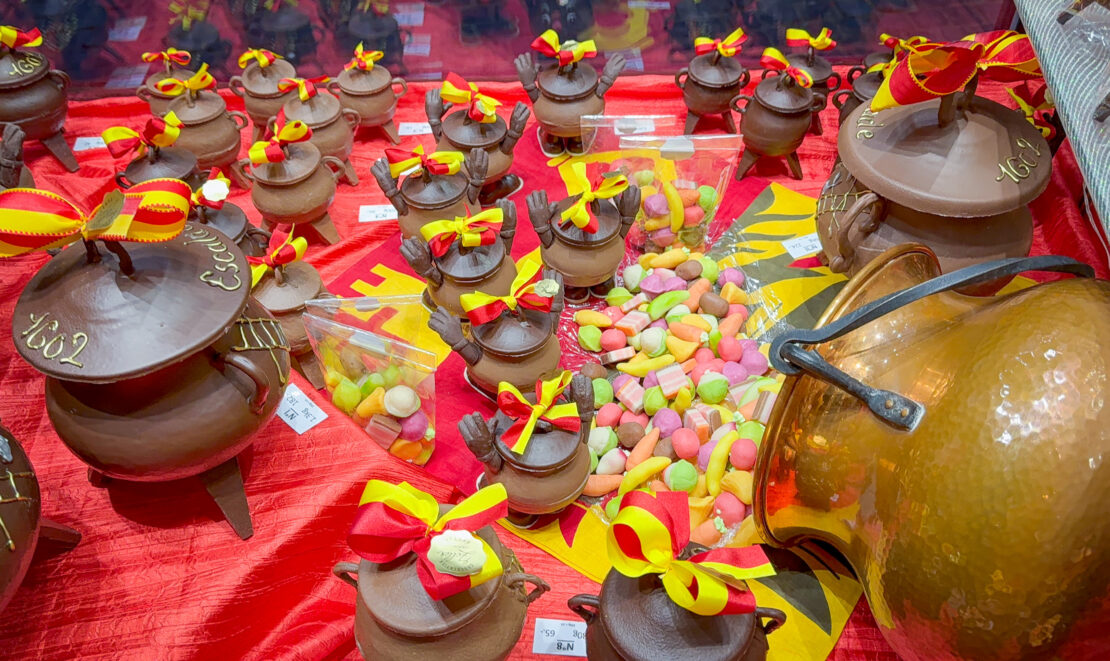
But one shop front caught our attention. It appeared to be a series of chocolate cauldrons.
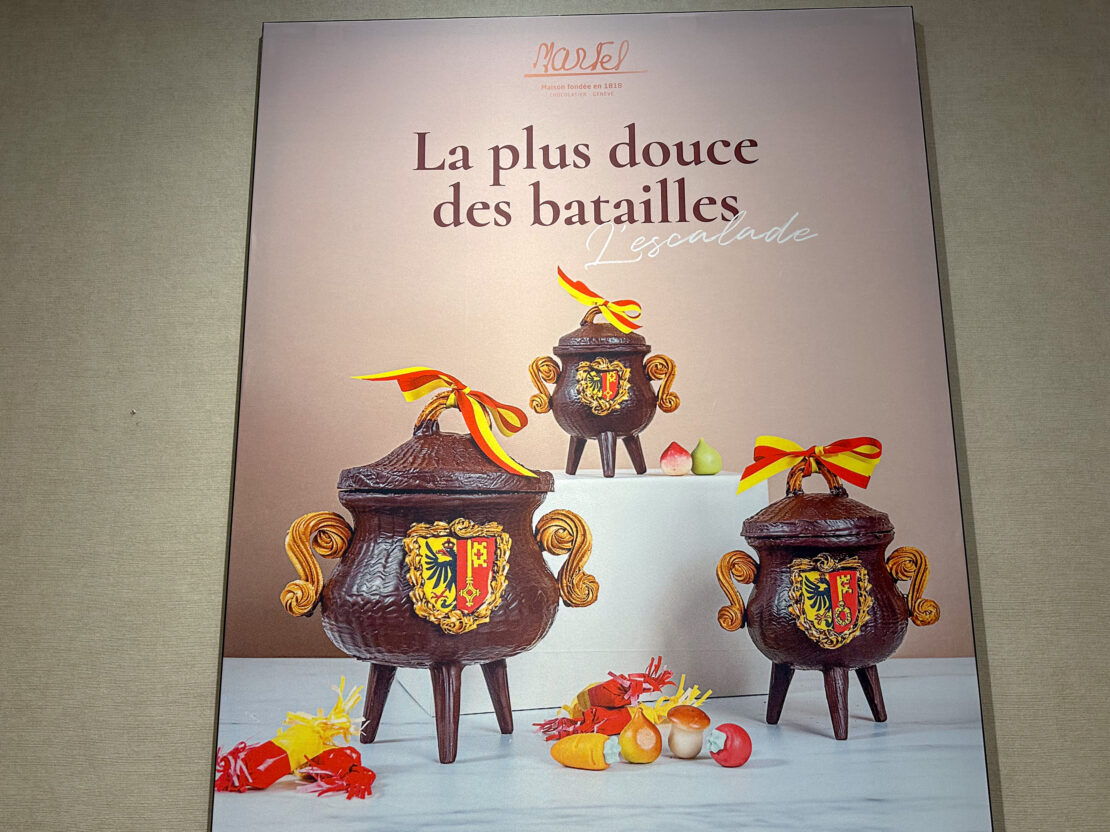
Every winter, as 12th December approaches, Genève prepares for its annual celebration of the fête de l’escalade. What began as a commemoration of a fearful night more than four centuries ago now fills the old town with lanterns, drums, vegetable soup and, perhaps most famously, the marmite de l’escalade: a chocolate pot, often made of chocolate and filled with marzipan vegetables and candies wrapped in bright foil.
Today, it’s the chocolate that gets the glory. But I hope you didn’t overlook the mention of the vegetable soup. Because that’s where the power of this story comes from.
Let me explain, perhaps with a little festive flourish.
This is the story not only of tradition, the traces still visible across Geneva’s old streets, but with a secret ingredient: the chance to step behind the scenes with local chocolatiers to make a marmite de l’escalade of your own.
Disclosure: we visited the city of Geneva on this occasion as part of a project with Switzerland Tourism and Geneva Tourism, although we have visited several times before. As ever, as always, we kept the right to write what we like. Otherwise, what’s the point? Also, if you book or buy through any of the links on this page, we may earn a small commission at no extra cost to you. Cheers!
The History of the Escalade
First, let’s set the scene, and travel back to 1602.
Geneva at the time was a small but fiercely independent city-state, Protestant in identity and surrounded by Catholic powers. It had proclaimed its independence in 1534 and trod a tricky balance between the bordering Swiss cantons and France.
And to understand this chocolate treat, we must first visit The House of Savoy, established in 1003 and growing to encompass all of mainland Italy and Sardinia. The last king of Italy was Savoyard, deposed as late as 1946. But we’re skipping ahead.
The Duke of Savoy Launched an Attack
In 1602, Charles Emmanuel was Duke of Savoy, and he launched a surprise attack in the early hours of a night of December when soldiers arrived silently beneath the city walls. The plan was to overwhelm the citizens of Geneva before dawn. His men carried a ladder to scale the fortifications, hoping to slip inside, open the gates and allow the main force to enter the city. If successful, the Savoyard troops would have taken the city and ended the independence of the genevois.
Then one woman changed the course of events.
Catherine Cheynel, known as Mère Royaume, lived in what was essentially a boarding house villa in the old town. She was preparing boiling vegetable soup for her large household when she heard unusual sounds outside. According to legend, she saw a group of attackers climbing the ladder and, acting on instinct, hurled her cauldron of boiling hot soup on the men directly below. The hot soup caused confusion and helped raise the alarm. Church bells sounded across the rooftops, the militia rallied, and the citizens of Geneva rushed to defend their city.
Whether every detail is true or not, the tale of Mère Royaume’s quick reaction has become a symbol of the city’s defiance. The attacker who tried to force entry through her window is said to have survived but not without becoming part of Geneva’s folklore. By dawn, the Savoyard soldiers had not taken the city. Geneva’s independence endured, confirmed soon after by the peace treaty of St-Julien.
The chocolate would come much later, but the roots were set that cold night in December.
A Chocolate Lesson in Genève
We first heard that story from a welcoming woman in Zeller, a folklore-style chocolatier with dark wooden panels and a life size chocolate cauldron. Such was our introduction to the savoyards, the enemies of the republic, and the Choco Pass itself.
Geneva’s chocolate tour is slightly different to the one I wrote about in Lausanne, but it follows a similar principle. Your ticket allows you to visit five chocolatiers from a wider range of participating artisans. Each shop varies in style and specialty, taking in modern, gleaming spaces designed for 21st century commerce, cosy cafes and places that look like a chocolate apothecary.
Each featured the marmites de l’Escalade. But one also offered training.
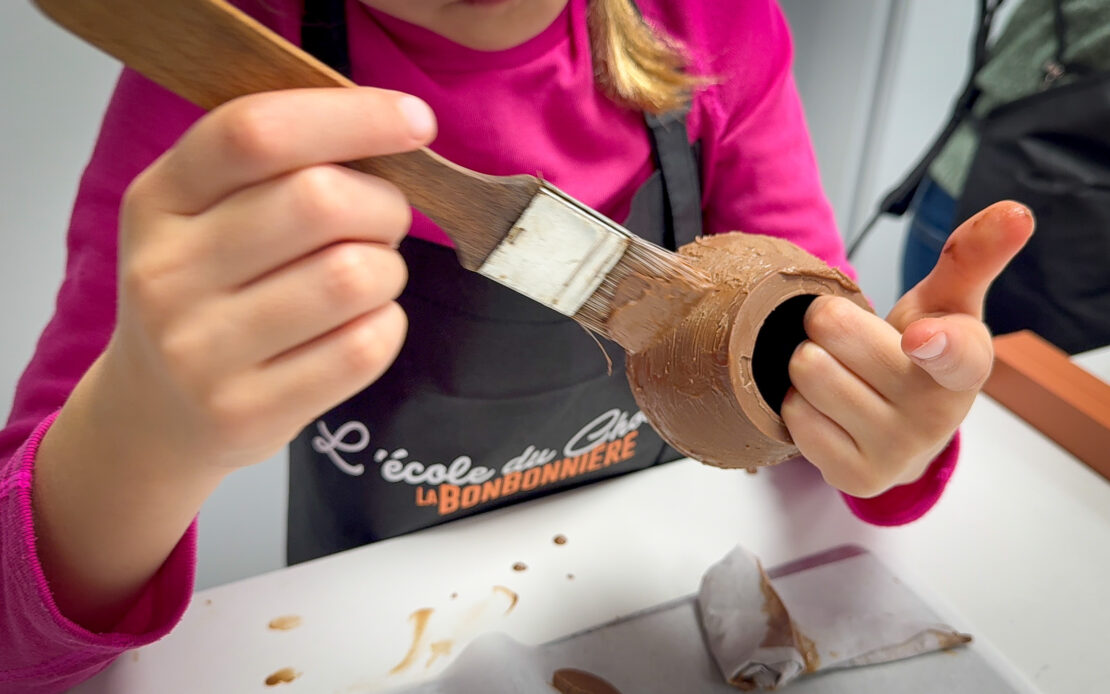
I’m always one for hands-on education. And so, we joined a throng of French and English speakers in the purpose built classroom above the Bonbonniere cafe and chocolatier.
Matthieu and Nima guided us through the process, with an initial video on just how the south american cocoa bean became one of Switzerland’s most famous products (short version: a scatty but brilliant engineer left his machine on too long, inventing the process that took away some of the bitter taste and instead made chocolate silky smooth.)
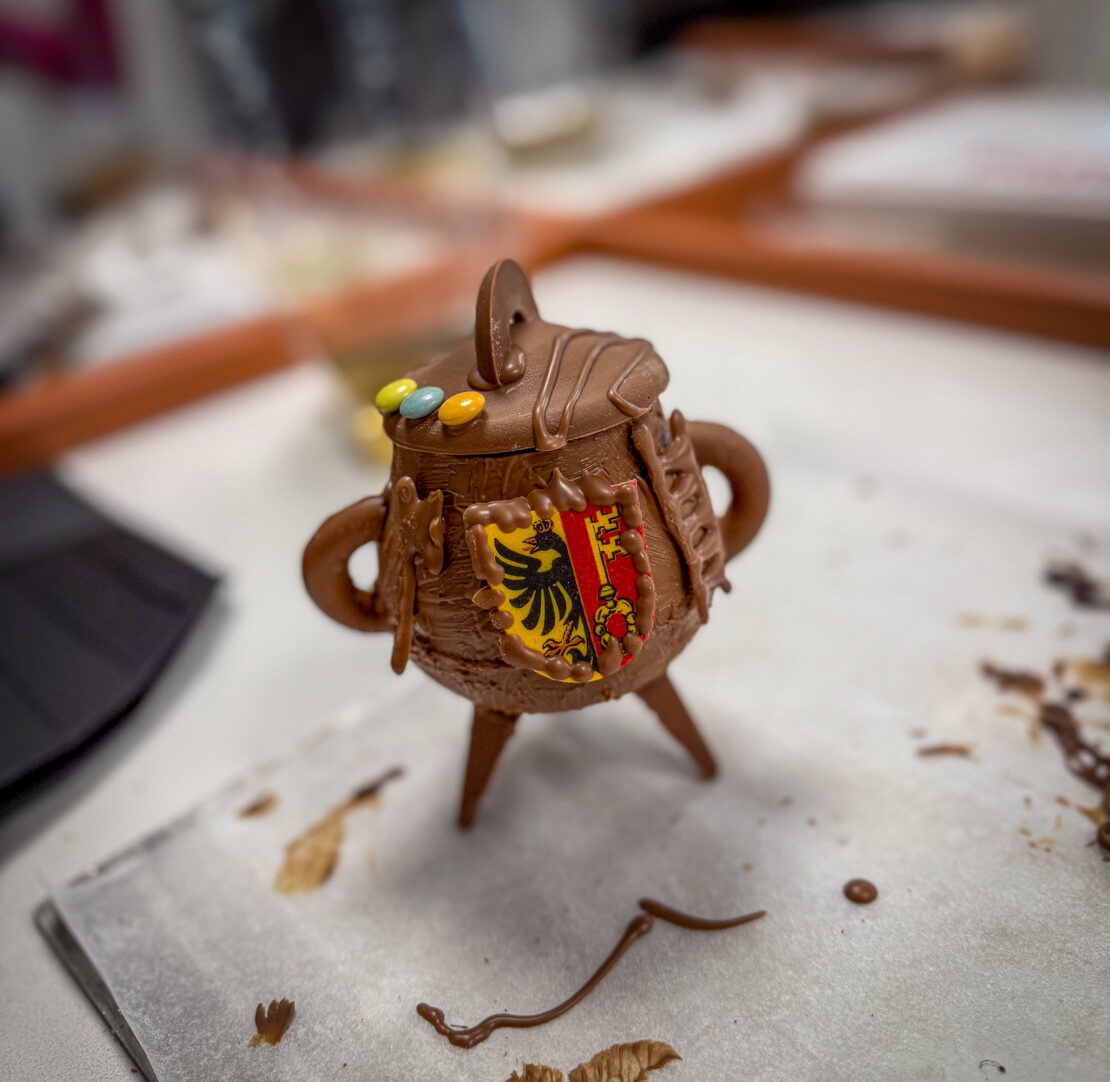
Being the beginners that we were, we were handed a pre-made chocolate cauldron. Our job was to affix the legs, handles and lid, construct some marzipan vegetables, and decorate the whole shebang.
I’ve rarely known two hours pass by so fast.
La Bonbonnière Chocolaterie has taps that ooze liquid chocolate and that’s what you use to fix the various components and create your own art.
For the vegetables, all those mornings spent playing with plasticine were put to good use, as I rolled coloured marzipan and exchanged ideas with my daughter.
But the final step has to take place at home. On the 11th or 12th of December.
How Geneva Celebrates Today
For the festival itself, Genevans bring to life historical reenactments, accompanied by music, processions and all kinds of merry gatherings.
The Compagnie de 1602 organises a series of events where participants in seventeenth-century dress parade through the old town, carrying pikes, muskets and flags decorated with the Genevan coat of arms.
Families and neighbours share vegetable soup in honour of Mère Royaume’s improvised weapon. And, as we saw, chocolatiers across Genève display rows of marmite de l’escalade in their windows, from tiny milk chocolate pots to elaborate beasts.
And then, the best part of the tradition.
Smashing the Cauldron
The youngest and oldest join hands before smashing the chocolate pot and scattering marzipan vegetables and candies wrapped in bright colours across the table.
And in case, like me, you were wondering how the Swiss stay so trim with all that chocolate and cheese, here’s another secret. The Course de l’Escalade brings thousands into the streets for a city run where costumes are welcome and good humour is essential.
All from soup on a group, as the story goes. A cheeky example of the spirit of the citizens of Geneva.
Practical Tips
- Plan your trip to coincide with the weekend closest to December 12 to make the most of the festivities.
- If you want to include a parade, visit 11-12 December. Otherwise, you will find the marmites in shop windows from mid November onwards.
- Look out for the stone statue of Mère Royaume and a soldier with a pot on his head, above the shop windows of a grand building. Yanick from Welo.Swiss can help you find it if you get stuck.
- Find out more about the Choco Pass here.
Switzerland Tourism
For more information on Switzerland, visit switzerland.com
Swiss International Air Lines (SWISS)
SWISS connects Switzerland with the world, offering more than 160 weekly flights from London Heathrow, London City, Manchester, Birmingham and Edinburgh to Zurich or Geneva. One-way fares start from £76 to Zurich and from £54 to Geneva, and include all taxes, fees and surcharges, one piece of checked luggage weighing up to 23kg and one piece of hand luggage. swiss.com
Travel Switzerland
Travel Switzerland’s Swiss Travel Pass offers international visitors to Switzerland unlimited travel on consecutive days across the rail, bus and boat network, plus scenic routes (seat reservation fees apply) and local trams and buses in around 90 towns and cities. It also includes the Swiss Museum Pass, which grants free entry to 500 museums and exhibitions. Prices start from £229 for a three-day second-class ticket. travelswitzerland.com