Let’s talk about the highs and lows of cycling between the mountains and the sea. Saddle up!
What to Know About Cycling in Albania
Albania is one of those places that still feels beautifully unknown, even though that obviously doesn’t apply to the people who live there.
It sits at the crossroads of the Mediterranean and the Balkan world, shaped by shadowy mountains and a glittering sea, Ottoman legacies, communist isolation, and a rapid re-opening to the world.
And cycling in Albania is one of the best ways to see as much of that as possible.
This article focuses mainly on southern Albania, because that’s where my own biking adventure took place.
However, I’ve also included recommendations and observations about northern Albania, particularly the Albanian Alps, based on widely used cycling routes, local advice, and conversations on the road.
A Country Made for Exploration
Look on the map and Albania seems pretty small. It’s only a twenty-five kilometre ferry ride from Greece, a country that we grew up with in school through legends about Aphrodite, Achilles and the founding of democracy.
Albania never got its fair share of the headlines.
But though it may be small on the map, it doesn’t feel small on a bike. The terrain is relentlessly mountainous, distances are deceptive, and the weather is changeable, so I wouldn’t say it’s the best choice for a cycling beginner.
This is not a destination designed for casual pottering nor heavily signposted leisure paths. An Albania cycling tour is best suited to experienced cyclists, or those willing to be flexible, curious, and occasionally uncomfortable – with a preplanned itinerary and a backup plan.
I booked through Headwater, for example, who planned the route and who moved my luggage from hotel to hotel, leaving me to focus on transport. I am not an experienced cyclist, although I have completed one trip like this in Austria’s Salzkammergut, and did complete an eight week training programme to prepare.
It was, for sure, a challenge. But the reward was worth every drop of sweat.
The reward was stunning landscapes, UNESCO World Heritage Sites, Ottoman bridges, thermal springs and the pure and simple thrill of discovering somewhere new.
Interested in active travel? Don’t miss our guide to fuelling long swimming sessions and this handy hiking holiday packing list.
A Quick Recap
- 340km route
- 4000m in climbs
- Snowy mountains
- Mediterranean beaches
- 3 UNESCO World Heritage Sites
- Europe’s last wild river
- And enough “Greek” salad to sink a ship 🫒
Roads, Traffic, and the Reality of Cycling Here
One of the most common questions people have when planning a tour of Albania is about safety. And as my departure date grew nearer, I heard a lot of scare stories about Albanian drivers.
Traffic
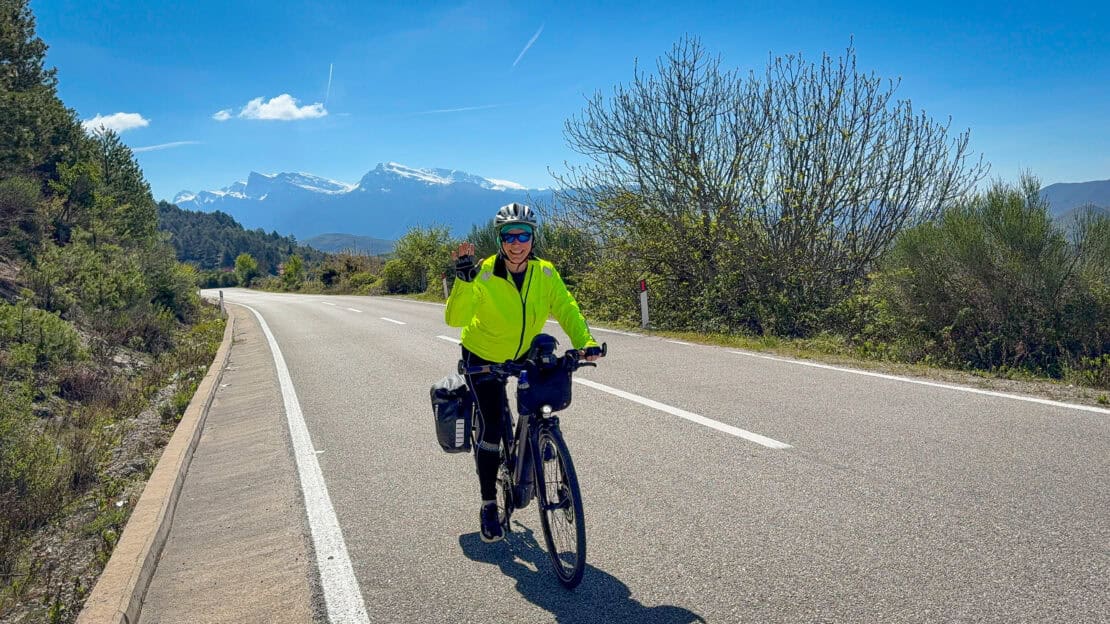
Traffic exists, of course, but on my bike route, I only worried about it on a few select roads. Albanian drivers are assertive, but generally aware of cyclists. You’ll share the road with livestock, horse carts, and the occasional tractor, particularly away from the coast.
Coming in and out of the cities, traffic is thick and bad tempered, but no different to home. The only time I felt hostility and aggressive driving was on a stretch coming in and out of Sarandë.
Now, this could have been bad luck, but I’ve also heard people tell me that this resort is not that welcoming towards foreigners in general (it’s had an explosion in building and development in recent years so perhaps has become the new Shagaluf of the Med, and consequently people are fed up of it.)
It’s hard to say based on only a single trip but I’m just sharing what I wish someone had shared with me.
Road Quality
Road quality varies dramatically. Newly surfaced tarmac can turn abruptly into broken asphalt or gravel, especially once you leave main roads. That makes flexibility essential when choosing an Albania bike setup.
A road bike with wider tyres or a gravel bike works well, while e-bikes are increasingly popular, especially on steeper mountain pass days.
On organised trips, a support vehicle can be invaluable, though independent riders will still find guesthouses spaced closely enough for realistic daily distances.
On my southern Albania route, roads were in far, far better condition than back in the UK, with smooth ribbons of tarmac slithering through the mountains looking absolutely pristine. Most of the roads were empty, too, so I rarely needed to worry about traffic.
Southern Albania: Mountains Falling into the Sea
Southern Albania offers some of the best cycling in the country, particularly if you enjoy dramatic elevation changes and coastal riding along the Adriatic. The region stretches between the borders with Greece and North Macedonia, dropping from high inland plateaus to sea level along the Ionian coast.
It was the thought of the Albanian Riviera which had drawn me here, all sparkling turquoise coasts and olive groves, but it turned out to be a lowlight of the trip. Not because it was disappointing. Rather that everywhere else was just so stunning.
Lake Ohrid and the Eastern Routes
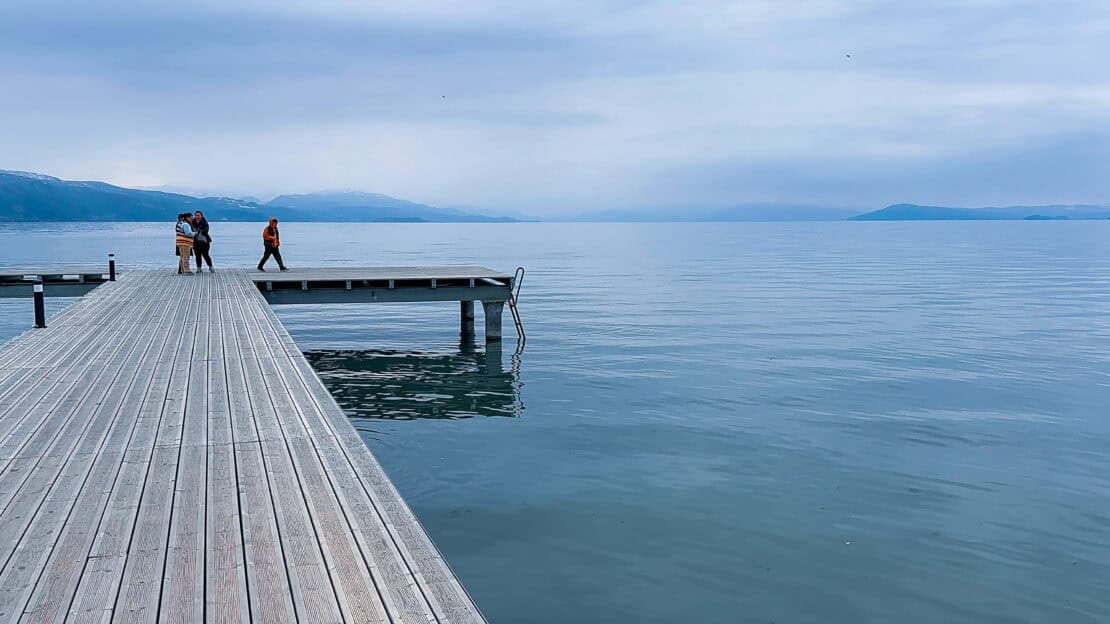
In the east, routes around Pogradec and Lake Ohrid offer some respite and a gentle chance to get to know your bike, with tranquil views across the border between Albania and North Macedonia and the chance to try some great fish (there’s a type of trout that can only be found here.)
Although, perhaps I’m underselling it. Because this is one of Europe’s oldest and deepest lakes, a UNESCO World Heritage Site in its own right for its immense biodiversity.
The easy riding is a trap, though. To get from the lakeside to the Korçë plateau, you must tackle the Qafa e Plloçës pass. It is a sharp, lung-burning ascent that forces you to leave the cool air of the water behind. But pause at the top: the view of the lake stretching out like a sheet of hammered blue glass is one of the finest farewells in the Balkans.
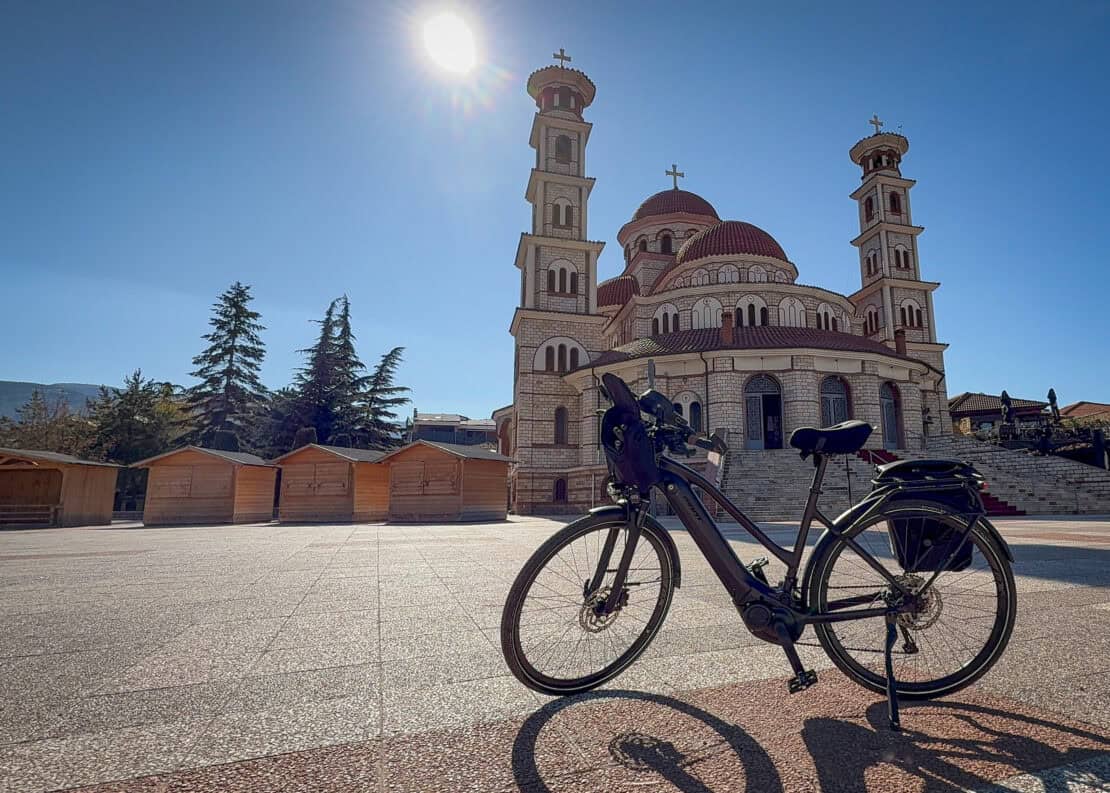
Korçë: the Paris of Albania
Korçë is the refined poet sipping espresso in a manicured garden. Often dubbed “Little Paris,” this city offers a surreal change of pace for the weary cyclist: the boulevards are wide, the architecture is neoclassical, and, joyfully, the city centre is largely flat.
Sitting high on a plateau, Korçë has long been the intellectual heart of the country. It was here that the first Albanian language school opened its doors in 1887, defying Ottoman bans to teach the ABCs of a suppressed identity.
Today, that legacy of culture hangs in the air, mixing with the aroma of grilled kernacka (meatballs) in the immaculate, recently renovated Old Bazaar.
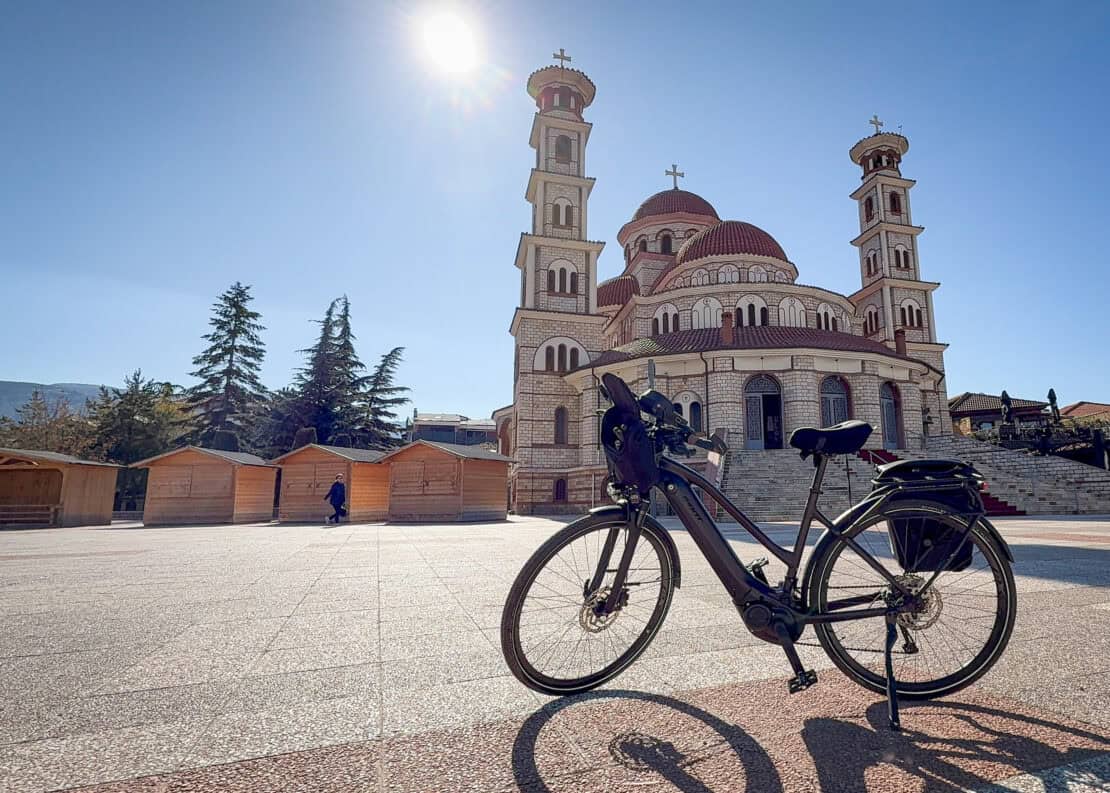
The skyline belongs to the colossal Resurrection Cathedral. It is a relatively new addition, rebuilt after the original was destroyed during the atheism campaigns of the communist era, but its sheer scale demands you stop and tilt your head back.
However, the true marvel for the culturally curious is the National Museum of Medieval Art. Housed in a striking modern building that looks like it belongs in Berlin rather than the Balkans, the interior is a dazzling “Golden Wall” of religious iconography. It holds over 7,000 items, including works by the master Onufri, whose secret recipe for a specific neon-pinkish red die died with him, leaving the rest of the world to simply admire it in jealous silence.
Cycling Tip: While the city itself is a joy to cruise around, remember that Korçë sits on a high plateau. The approach usually involves a significant climb from the valleys below, but rolling down those tree-lined avenues afterwards feels like a genuine victory lap. Plus, it’s easier to explore the centre of Korçë on foot.
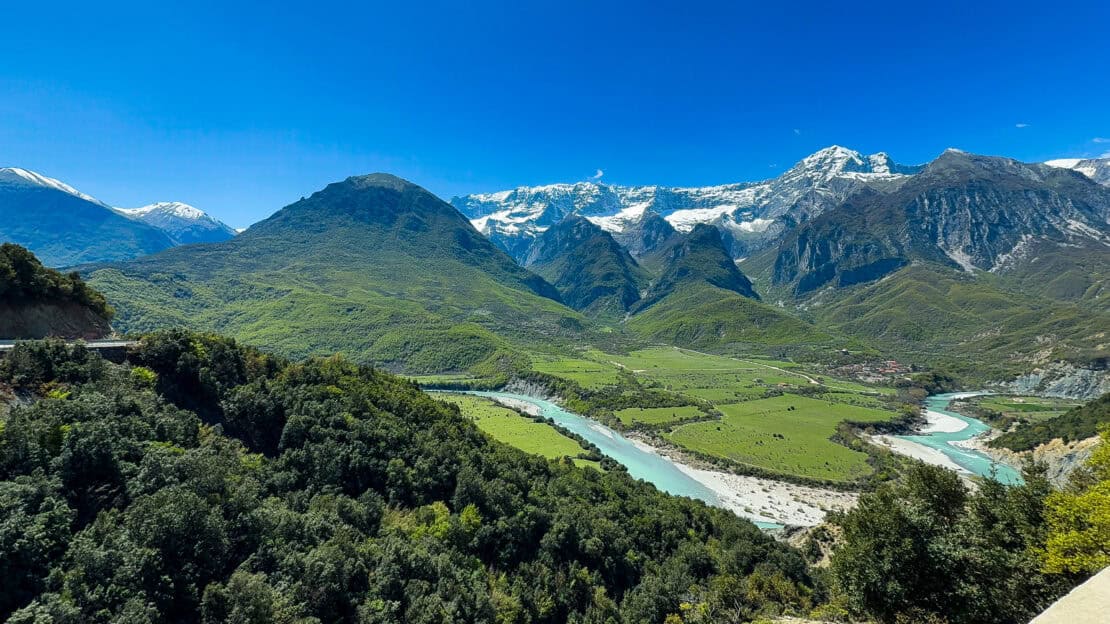
The Gramoz Mountains and Europe’s Wildest River
Leaving the polished boulevards of Korçë, the route abruptly shifts gears. You are now hugging the spine of the Gramoz Mountains, the jagged frontier that stitches Albania to Greece. This is deep country, passing through traditional villages where the only traffic jams are caused by goats and the concept of “rush hour” feels like a foreign language. The beautiful unknown.
The climbing is significant, but what goes up must come down – even in the Germenj-Shelegur National Park. The descent from Shelegur is a cyclist’s dream: a gravity-fuelled swoop that drops you from alpine pine forests down to the banks of the Vjosë (Vosja) River.
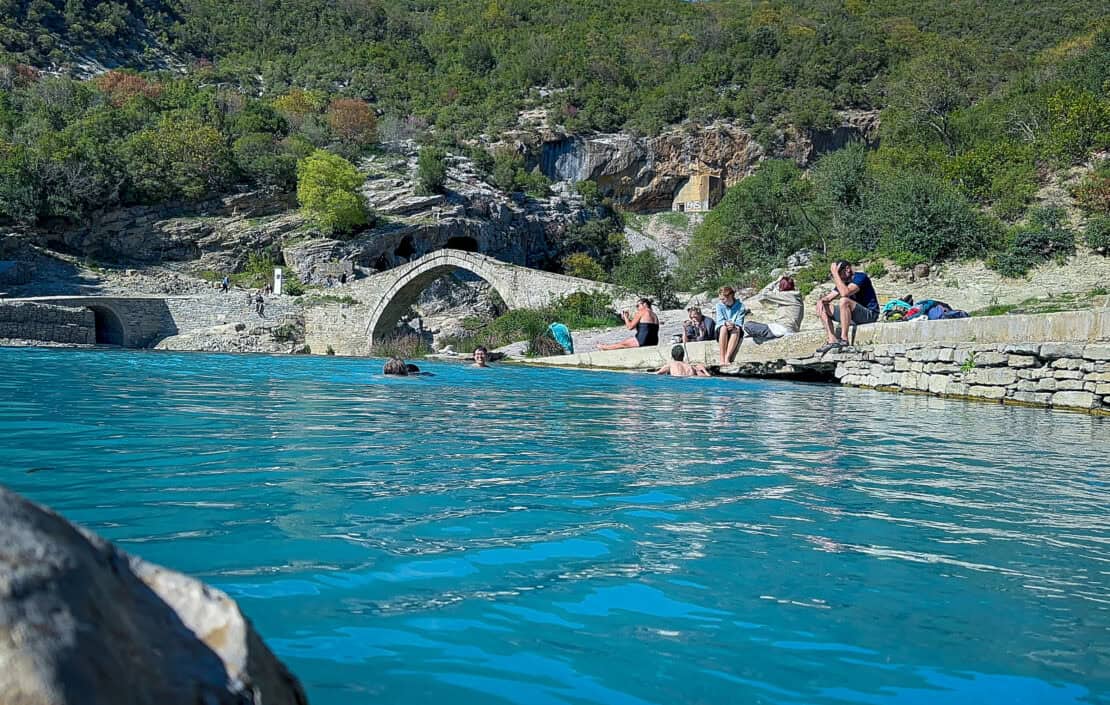
Pit Stop: The Thermal Springs of Benjë
Situated near Përmet, the Benjë Thermal Springs offer natural pools of sulphurous, warm water heated by the earth’s core, overlooked by a staggeringly well-preserved Ottoman-era Bridge.
At the moment, it’s a bit of a mission to reach the water – you need a head for heights and mild disregard for health and safety, but the building work going on makes it seem as though that will soon change.
Refreshed, the route continues by slicing through the massive Trebeshina and Nëmërçka mountain ranges. The road threads the needle of the Këlcyra Gorge, a dramatic corridor of vertical rock and turquoise water that spits you out, eventually, at the foot of Gjirokastër.
Cycling Tip: pack a travel towel with your swimwear and some waterproof shoes for the slippery rocks.
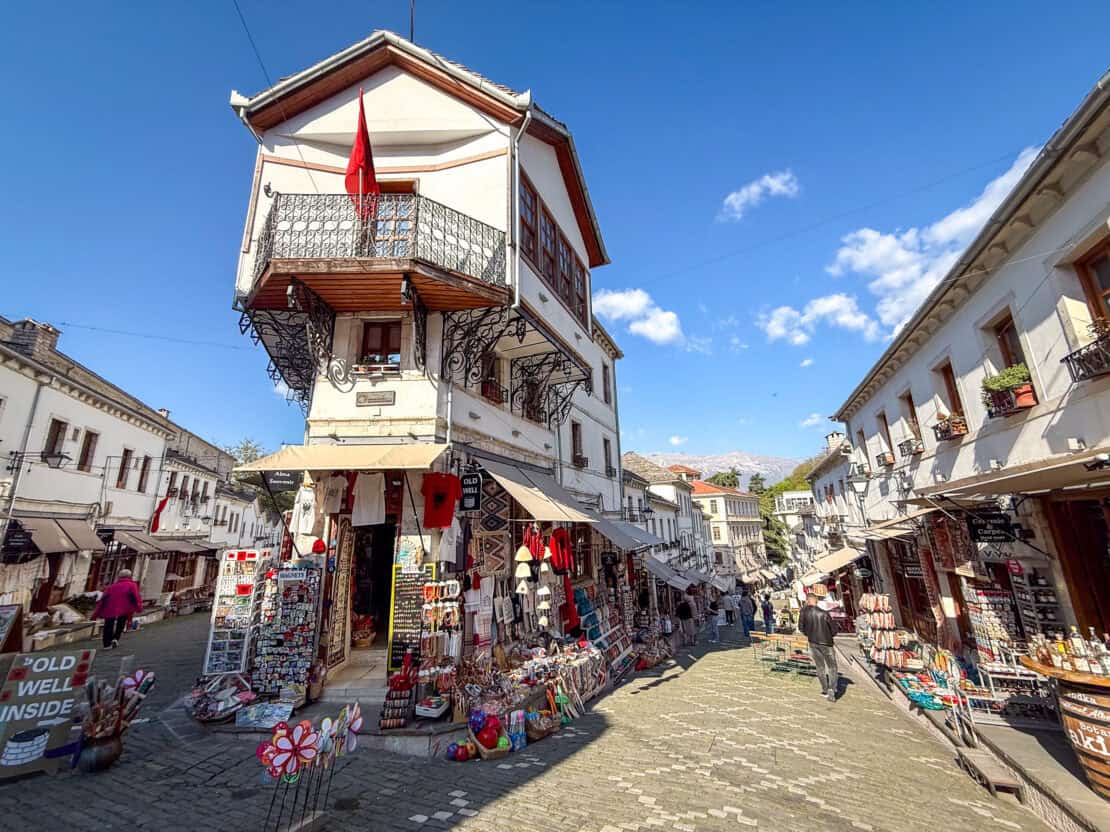
Gjirokastër: The City of Stone
Gjirokastër, the “City of Stone,” makes you work for its affection. If your legs were complaining on the approach, the final ascent up the steep, cobbled streets to the UNESCO-listed old town will have them screaming.
But earning your views is part of the cyclist’s credo, and Gjirokastër pays its debts in full.
Perched on the side of the Drino Valley, the town is a cascading tumble of Ottoman-era mansions with slate grey roofs that glimmer like silver in the rain. It is arguably the finest surviving example of an Ottoman merchant town, though it owes its preservation less to merchant wealth and more to the whims of a dictator: this was the birthplace of Enver Hoxha, ensuring it was designated a “museum city” while others crumbled.
Dominating the skyline is the Gjirokastër Castle, a fortress so imposing it feels less like a building and more like a geological feature. It’s worth parking the bike to explore the eerie interior, which includes a captured US Air Force jet, a bizarre Cold War trophy that sits incongruously amidst ancient stone arches.
Below the castle, you can visit the chilling, in every sense of the word, bunker built for head communist officials in the event of nuclear war.
Outside is much cheerier. The Old Bazaar (Qafa e Pazarit) offers a slightly perilous walk on slippery cobblestones, but the risk is worth it for the artisan shops and cafes, a blaze of scarlet cushions and coverings.
Cycling Tip: The “cobbles” here are slippery, uneven limestone slabs. Unless you are riding a mountain bike and possess the balance of a mountain goat, it is infinitely more dignified (and safer) to dismount and push your bike through the steepest parts of the Bazaar.
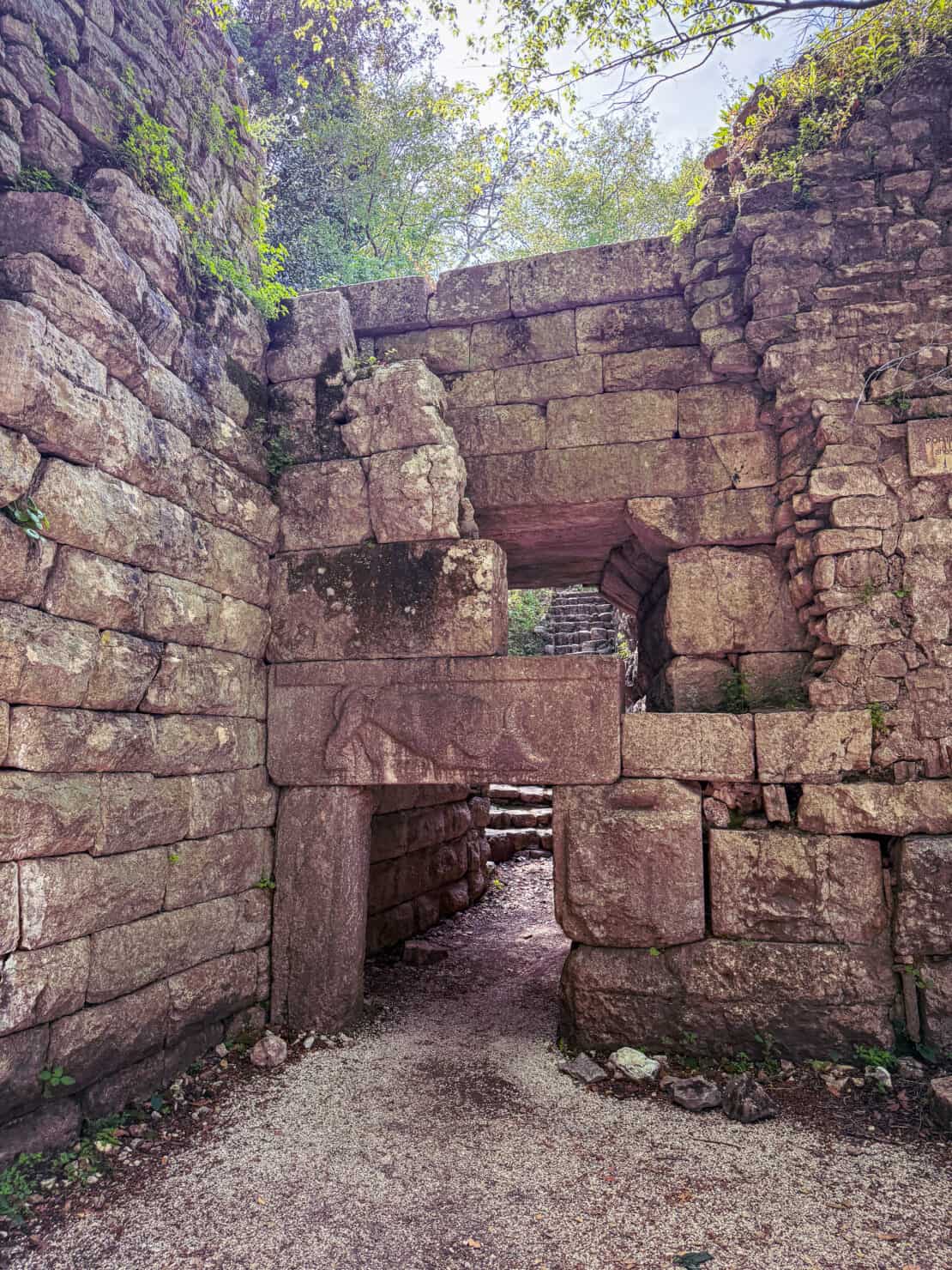
Butrint
One of the best archaeological sites in Albania has the good manners to sit within a stunning national park.
The approach from the Muzina Pass to Butrint National Park is a delight of salt marshes, reed beds and lagoons.
Then, there’s one of the shortest ferry rides in the world, with floating planks and ropes, to reach the UNESCO World Heritage ruins themselves.
It’s mildly amusing to realise that whether I’m in Egypt or Albania, Julius Caesar got here first. Butrint was first a Greek colony but Caesar made time to make it here in between his crushing of the Gauls and seduction of Cleopatra.
After the Romans, Butrint became a Byzantine bishopric before falling into disrepair, as so many of us do, in Middle Age.
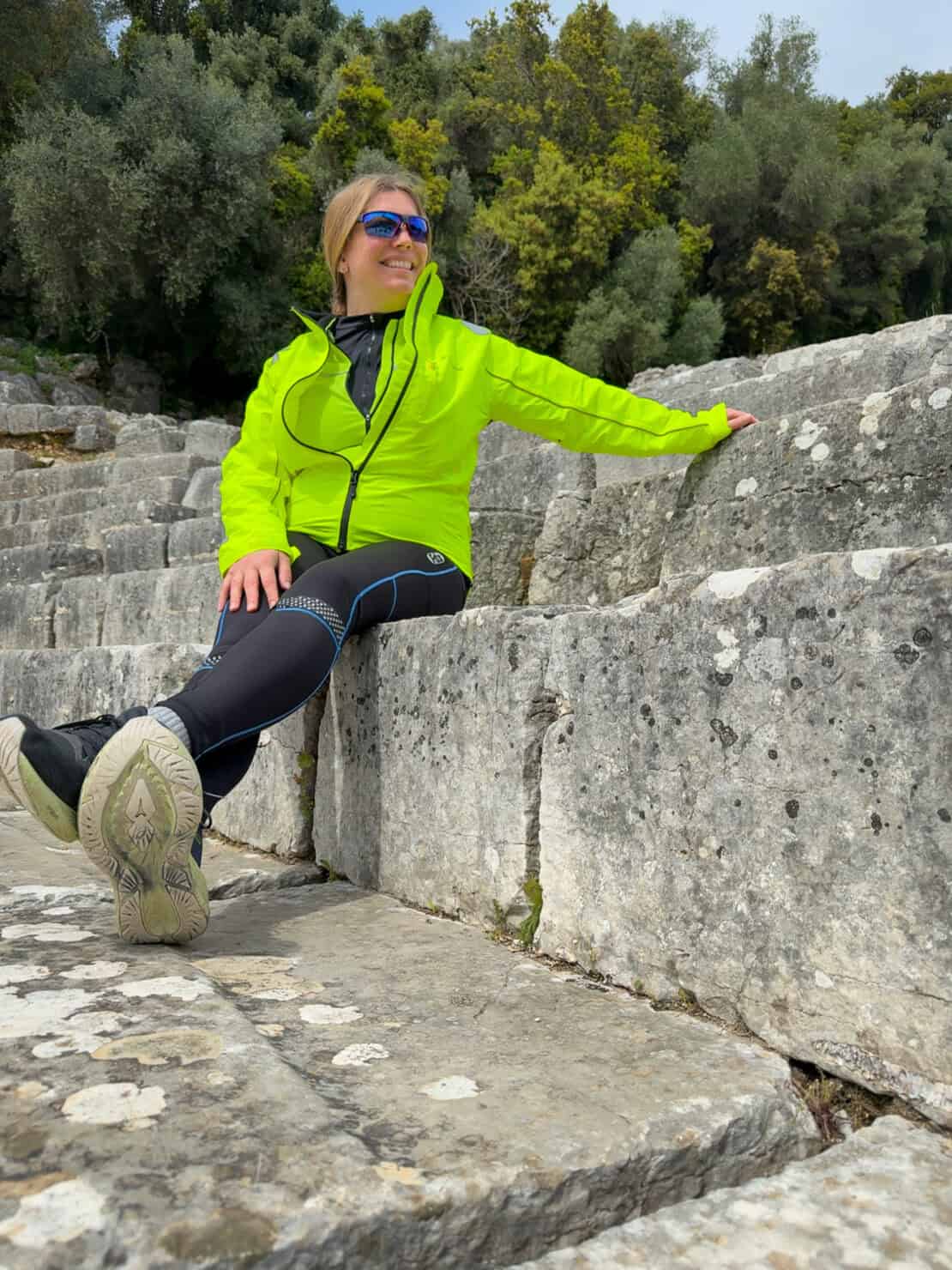
The ruins may not be the grandest in the Roman world but they have one of the best views. As you walk through the ruins of theatres, temples, and basilicas, it’s easy to imagine the people who lived here feeling pretty pleased with themselves.
It’s easy to leave your bike at the entrance, where there’s also a handy restaurant for refuelling.
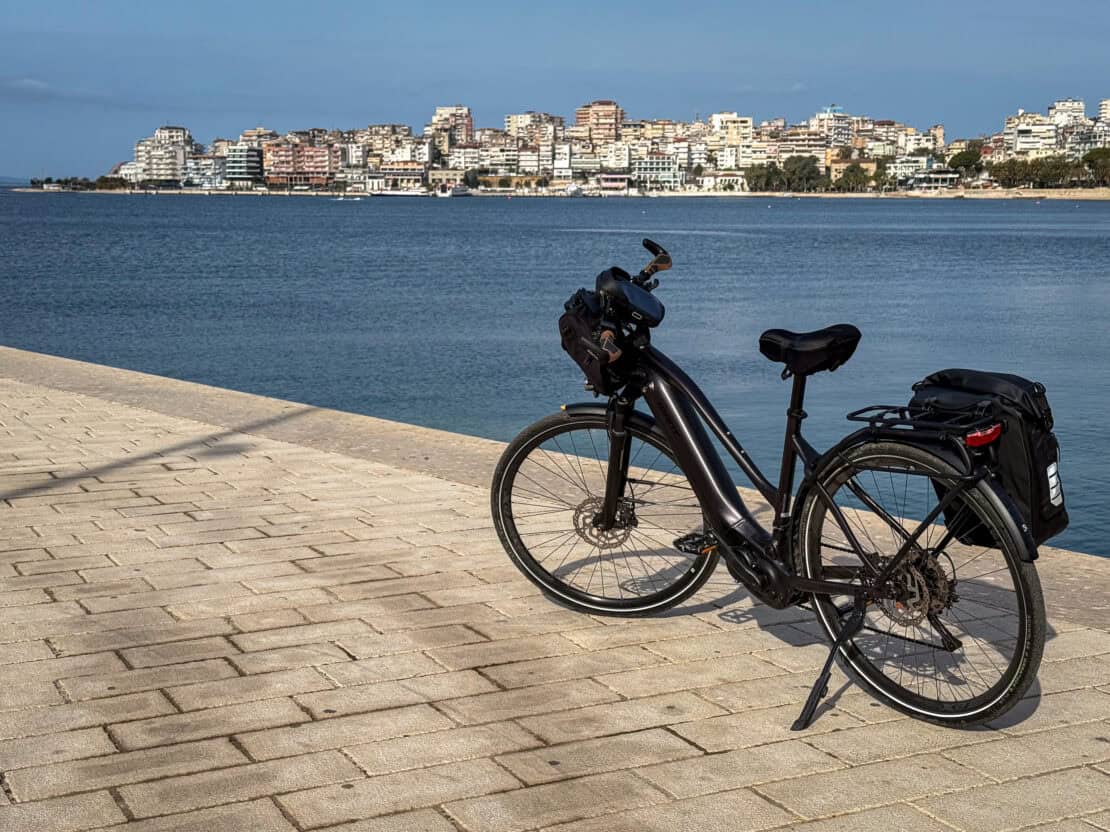
Sarandë and Himare
These are the two main coastal cities, tracing the glistening Ionian Sea in and around the bay of Potam and its coastline. It’s a curious blend or tiny hamlets from a bygone age and beach resort building at a frenetic pace. This is the only place where I sensed any hostility from drivers – and some teenage kids while passing through the bigger towns.
These are the highlights if you love beach resort life; less so if you long for immersive cultural experiences. But with that said, it’s hard for anyone to resist the waters of the Ionian sea completely.
Northern Albania and the Albanian Alps
Although my own cycling tour focused on the south, northern Albania is frequently recommended for those seeking rawer landscapes. Around Shkodër, routes head into the Albanian Alps, where roads become narrower, climbs steeper, and villages more remote. This region is colder, wilder, and better suited to riders confident with long mountain days and limited services.
Many cyclists consider this the most dramatic part of a tour in Albania, particularly for those drawn to mountainous regions rather than coastal riding.
Another highly recommended area that I haven’t been able to check out yet is cycling through the Llogara National Park and tackling the Llogara Pass.
Plus, you can link cycling trips in Albania to neighbouring countries and on to Montenegro, if you really fancy a challenge.
Food, Fuel, and Everyday Generosity
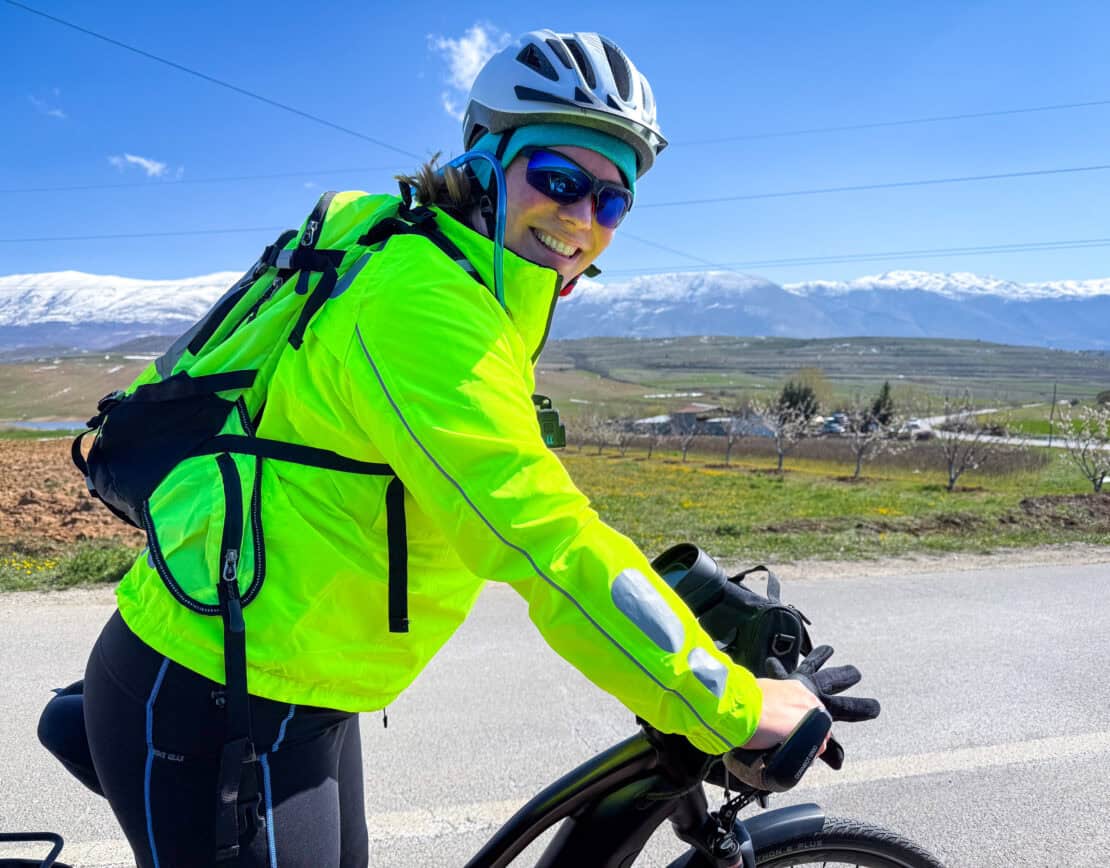
You need to plan a little when cycling through the countryside. Cafés appear even in tiny villages but they can be far apart.
Albanian cuisine reflects a mix of Mediterranean and Balkan influences: goat or lamb cooked slowly, freshly baked bread, salads bright with herbs, and local cheeses that change from region to region.
Along the coast, seafood appears more often, while inland meals are heartier. Meals are generous, prices are low, and no one seems surprised that cyclists eat like they’ve earned it. Raki is often offered in the evenings, alongside local wines, particularly in agricultural areas.
Practical Tips for Visiting Albania
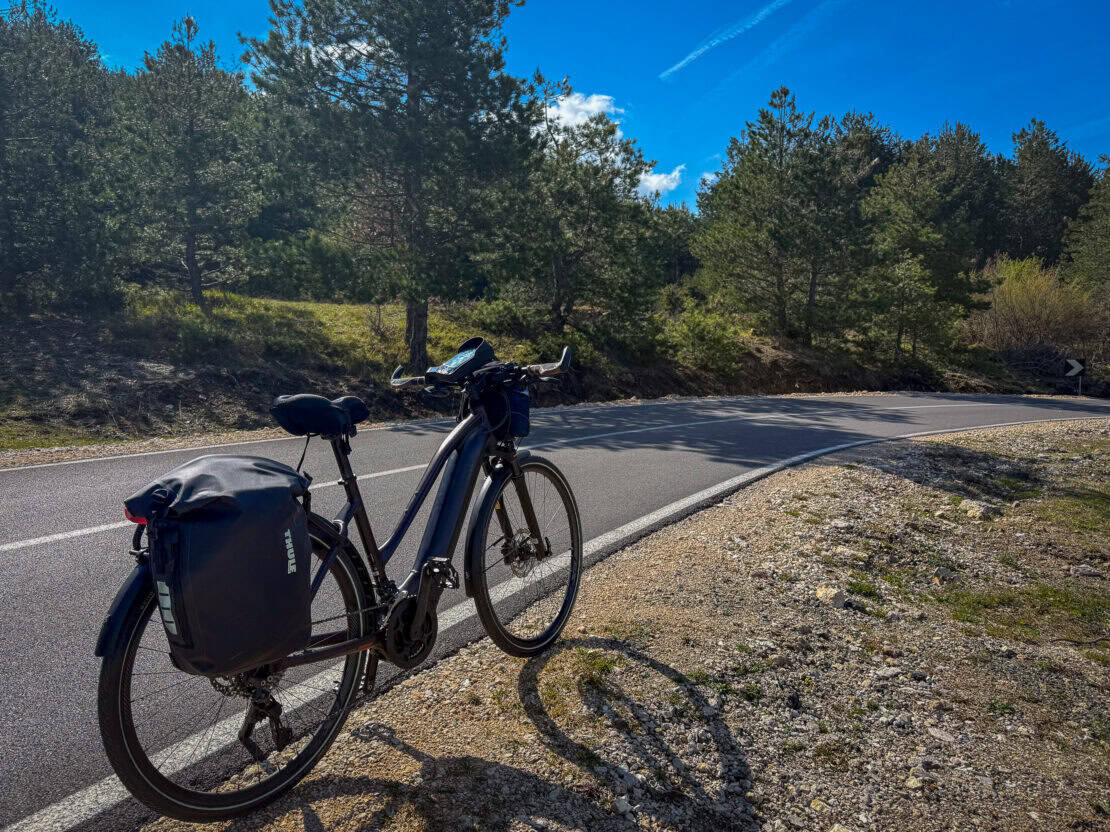
Albania has a Mediterranean climate along the coast, but conditions change quickly inland. Spring and autumn are ideal, while summer heat can be intense, especially along the coastal roads and at sea level.
Bear in mind that temperatures change sharply from the coast to the snowy peaks. Even in April, when we arrived from Tirana to the shores of Lake Ohrid, ice and snow surrounded us (and I was not well prepared.) Learn from my mistakes and check out our guide to packing for a cycling holiday here.
Visa requirements are straightforward for many nationalities, but always check current rules before planning a tour in Albania. Borders with Greece and North Macedonia are well established, and crossing them by bike is usually uncomplicated.
- Recommended reading: is Athens worth visiting?
Who Should Go Cycling in Albania?
This is not a destination designed for leisurely family bike tours. Albania is best approached as a biking adventure and I’d highly recommend booking through a company or travelling with a guide. I travelled with Headwater and would highly recommend them. Areas are scenic but still quite remote and it’s essential to plan your route in Albania before you set off.
Consider an e-bike if you’re unsure. The mountain paths reach 1200m elevation and you don’t have to have it on all the time (in fact, when I went, the battery could only power about an hour a day, leaving the other 5-8 hours fully powered by me).
Overall, though I hate to generalise, I’d say that the Albanians I met were welcoming, often curious, and generous with their time.
Cycling here opens doors that cars do not, particularly in rural Albania.
Why it Stays With You
Albania is mountainous, coastal, historic, and modernising all at once. To go cycling here is to experience that directly, moving through landscapes shaped by isolation and openness in equal measure.
Whether you follow a defined cycling route along the Ionian coast and waters of the Adriatic, climb through national parks, or trace quieter inland roads, Albania offers something increasingly rare in Europe: the feeling that you are discovering a place on its own terms, not being squeezed through a tourist funnel.
And that, more than smooth roads or perfect logistics, is what makes cycling in Albania unforgettable.
More on Southeast Europe
- What is Croatia famous for?
- How to spend one day in Dubrovnik
- Beautiful and unusual things to do in Greece
- Your Peloponnese itinerary for a road trip through mainland Greece
- What to pack for Greece: a packing list to download
- Fun facts about Greek food
- The best things to do in Kalamata in the Peloponnese
- The best Peloponnese itineraries