
A voyage to Some Galapagos Islands facts you learn from books. Others you learn from a kayak at sunset, still searching for one very elusive bird.

The Bird at the Heart of the Galapagos
As names go, it’s one of the lip-twirling best: the blue-footed booby.
As wildlife sightings go, it lives up to the hype of its name.
Boobies, of the red, blue and Nazca-footed variety, thrive in the speckled volcanic islands of the Galapagos, 886 miles from mainland Ecuador.
Or so I was told.
Three days into my exploration of the Galapagos and I’d yet to glimpse those iconic blue feet.
Boarding a Galapagos Islands Cruise
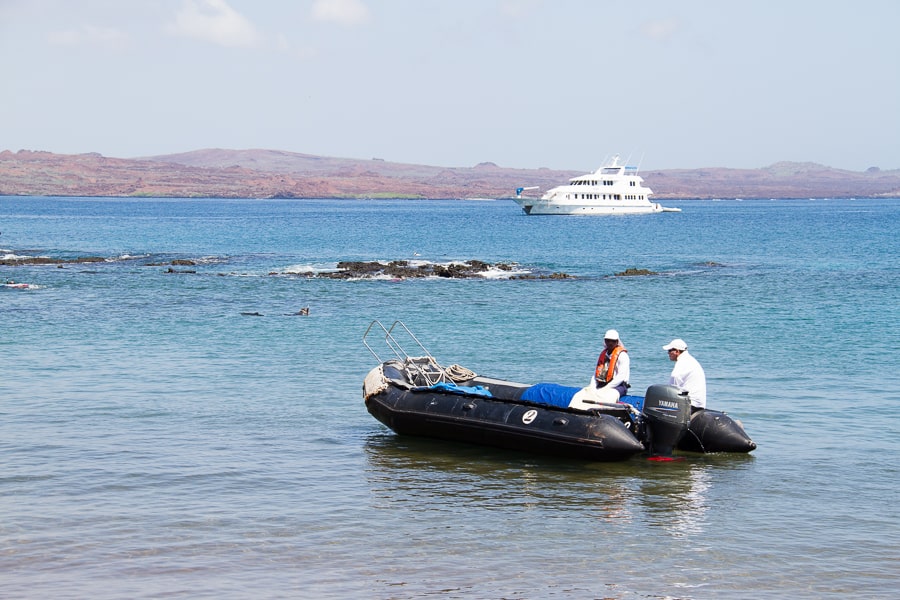
Of course, blue dazzled in the sky overhead as we touched down from Guayaquil and took a bus, a boat and a bumpy car ride to board La Pinta at Santa Cruz.
And blue passed in shades from charcoal to midnight to aquamarine as we travelled around these windswept isles.
But blue in the form of a booby? Not on the natural side of things.
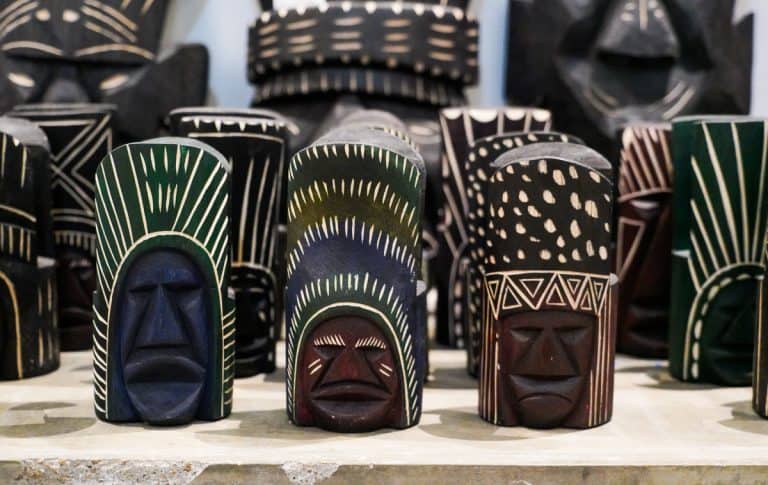
I mean, there were T-shirts, sure, and plastic figurines. Cheery waddling cartoons and soft, startled stuffed toys.
But the real deal?
Not yet.
Why Visit the Galapagos Islands?
Now the strange thing is, I didn’t come to these islands with this obsession.
I came, as so many do, to retrace the footprints of science.
To reach out and touch, in an invisible, ephemeral way, the spark of inspiration that led Darwin to think through the Theory of Evolution.
It is not the strongest of the species that survives, nor the most intelligent that survives. It is the one that is most adaptable to change.
As it turns out, Darwin never said those words. A 1960s business coach came up with them based on Darwin’s work.
And when you drill down into the original text, it’s clear to see why.
Curling up in the (blue) library of La Pinta, I take my first dip into Darwin’s landmark publication: the Origin of Species.
And it is not an easy read.
Despite having studied the overall concept (at length), this is my first foray into the book itself. And it’s drier than a camel’s tongue after a record-breaking extension of dry January into March.
“Man is descended from a hairy, tailed quadruped, probably arboreal in its habits.”
Turns out business coaches earn their money after all.

Darwin Wasn’t the Only Voice Behind Evolution
As I’ve said before, I can’t help but notice that our society obsesses over stories of overnight success and one-man bands. The reality of collaboration, failure, persistence and blind luck just ain’t sexy enough to sell.
And sure enough, a look at Darwin’s time in the limelight reveals the same thing.
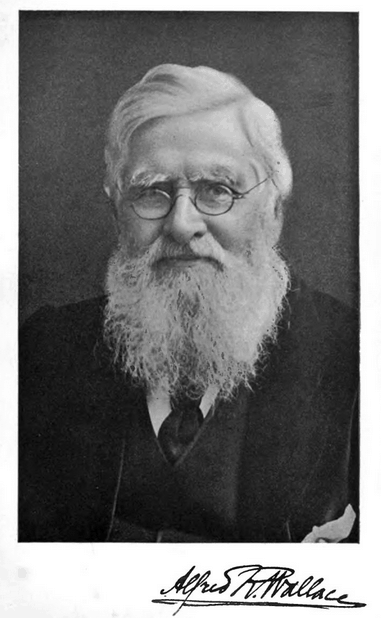
Peers of his time had similar thoughts, in particular the Welshman Alfred Russel Wallace.
He also proposed the theory of evolution through natural selection and published his work alongside Darwin’s (kicking the former into action to get on and publish his book. Let that be a lesson to us all. Get on and publish the book!)
Not that I mean to diminish Darwin himself. Just to reflect on the multistep, multi-brain nature of progress and success.
And perhaps I feel bad for Wallace – where’s his Cambridge college? His award for the silliest way to die?
Darwin and His Trip Through the Galapagos
Still, what’s not up for grabs is the fact that Darwin – a young man from Shrewsbury in Shropshire – made his way to these remote islands aboard the H.M.S. Beagle, which left England in 1831. For five weeks of a FIVE-YEAR voyage, he watched and catalogued the wildlife he found on these islands.
It was, perhaps, the ultimate voyage of discovery (even if the Eureka! moment didn’t arrive until years later).
The Origin of Species and the Birds
The 502-page tome talks a lot about finches and the curve of their beaks. This was the clue that helped put the theory together: that on different islands, finches had different beaks.
But coming here with the advantage of hindsight, such differences are even easier to spot.
Red-footed boobies nest on the ground; the elusive blue-footed booby lives in and around white speckled cliffs.
On land, boobies look clumsy and unwary, earning the name bobo – or stupid – from those early Spanish explorers. The Spanish gave the islands their name, too – here’s what the word Galapagos means.
I, too, look clumsy and unwary, riddled as I am with a gastroenteritis bug I managed to pick up before I reached this pristine environment.
Watching the World Go By
While the other 48 or so guests snorkel with penguins and shimmy up to sea lions, I’m confined to four walls with dry biscuits and water, quite literally watching the world go by.
Luckily, I’ve a pretty good view. The cabins have floor-to-ceiling windows and the view changes from one minute to the next.
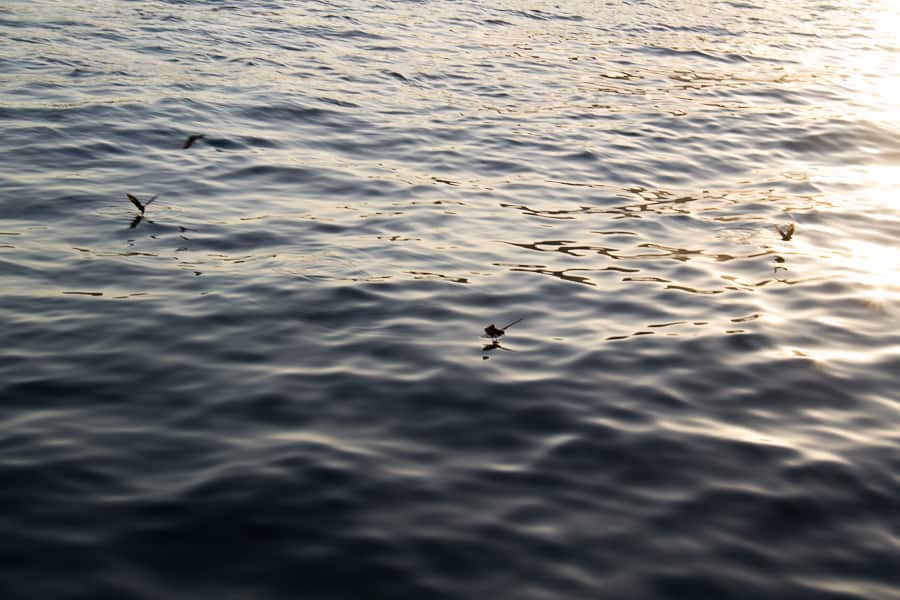
After half an hour of watching ripples chase themselves across the surface, the curved limb of a turtle flips with great nonchalance out of the waves.
It holds, it eases, the head pops up for air, then the creature lollops back down to disappear beneath the blue.
I lollop in my bed and reach for more rehydration salts.
But by day three, I’m taking tentative steps on shore.
And what a shore it is.
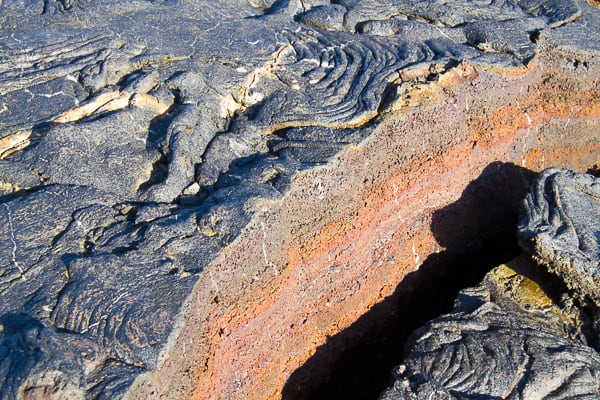
White, bright, tight sand that squeaks out in its emptiness lies surrounded by jet-black rock and scarlet scorpions.
As we wade to shore, the scorpions morph into beach crabs that scuttle and buckle into obsidian rockpools and glassy black swirls.
That’s the power of the Galapagos: one creature can change into the other.
That, or that dehydration and fever can leave a non-marine biologist more than a little confused.
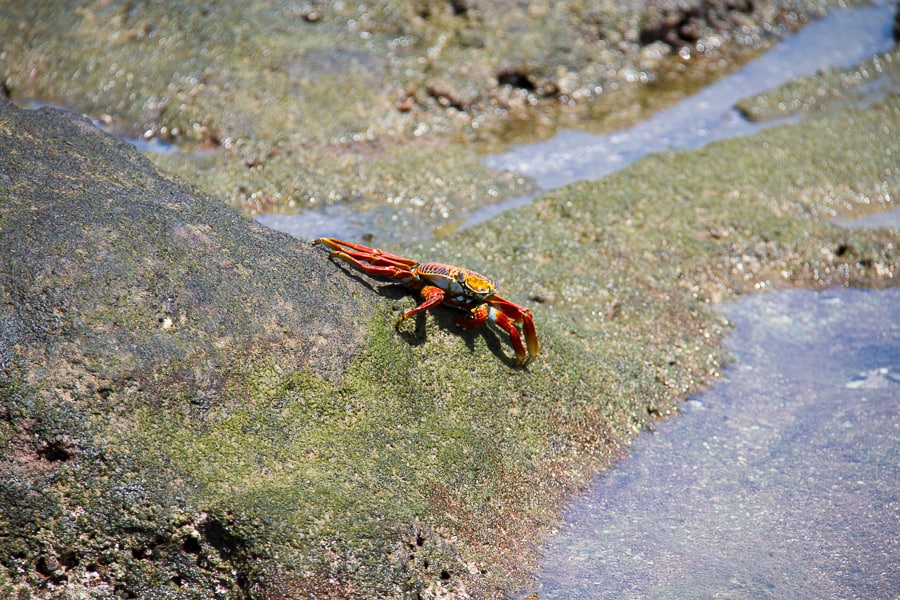
Indeed, they are crabs, as one of the two naturalists from La Pinta strides over to read me the riot act.
In my sickness, I’d missed the original briefing.
In the Galapagos National Park, we’re to stick to strict paths in order to protect the wildlife. Landings are limited, both in human footfall and time on land.
I haven’t actually done anything wrong – but I looked as though I might, which is enough with such high standards to maintain.
So I slope away from the crabs and slip on a snorkel instead.
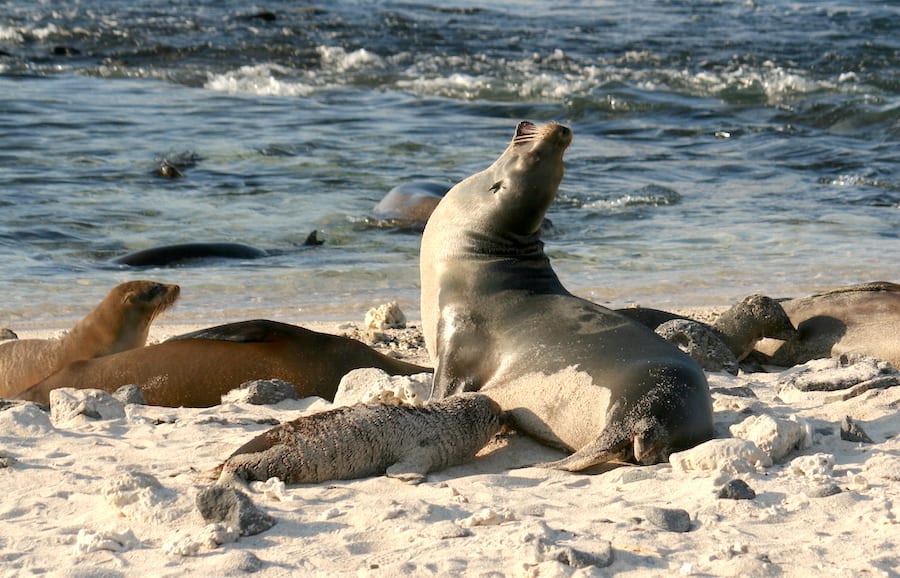
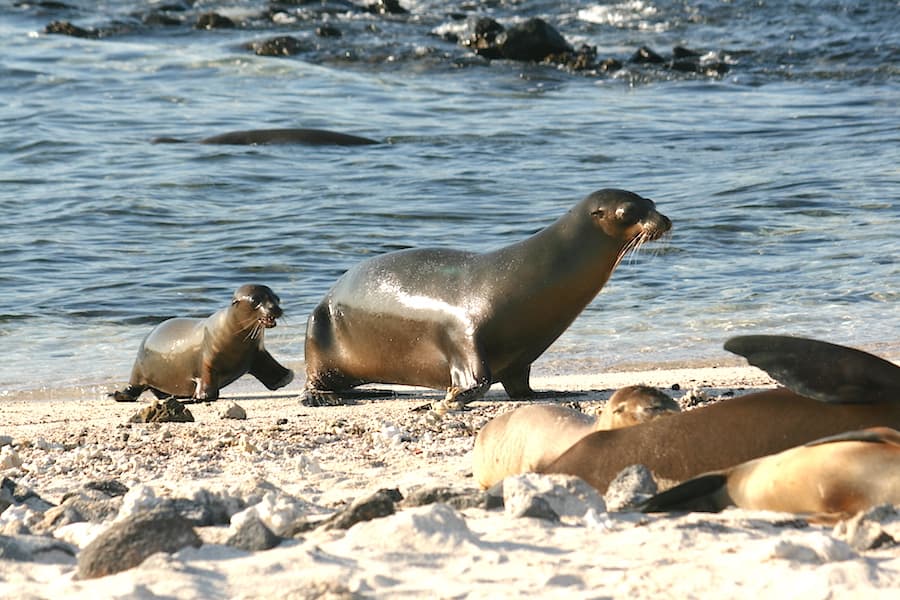
And after patient birdwatching, I catch sight of my first sea lion: a baby dozing on the shore.
The baby wriggles and fliggles and wobbles toward me, making noises that would warm the coolest and most cynical of hearts.
I smile, but it’s another of nature’s traps.
I’m hauled away soon enough by the vigilant naturalists.
“But she came to me!” I cry in an embarrassing flashback to schoolyard defence and justification, wondering what I’ve done wrong.
“She’s blind and thinks you’re her mother.”
I blink for a moment. That is blind.
“Any movement confuses them and she’ll waste all her energy trying to reach you.”
I huddle into my human crowd and take photographs of skulls and long bones instead.
Environmental Protection in the Galapagos
The islands were the first place ever added to UNESCO’s World Heritage List, back in 1978. Yet, I don’t envy the task of protecting this place, of these keepers who need to play god.
The absurdity is, of course, that our eco behaviour directly challenges the natural principles in science these islands brought into focus. A point made all the more interesting at the self-named Charles Darwin centre that protects giant tortoises from extinction by shielding them from the wild.
I cannot persuade myself that a beneficent and omnipotent God would have designedly created parasitic wasps with the express intention of their feeding within the living bodies of Caterpillars. Charles Darwin, letter to Asa Gray
But, there’s still no sign of the booby. The blue-footed one that is.
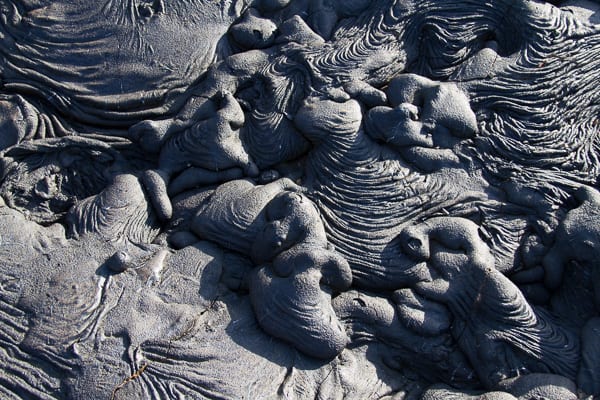
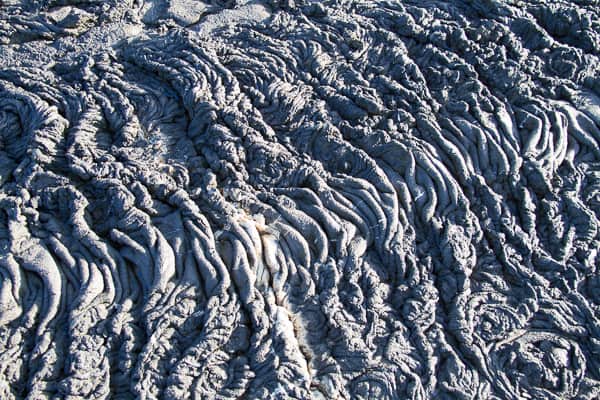
On a hike along another island, the scraggy undergrowth teems with the red-footed one. We find adults, fluffy babies and marital couples squabbling over the tidiness (or rather lack of it) of the twiggy familial nest.
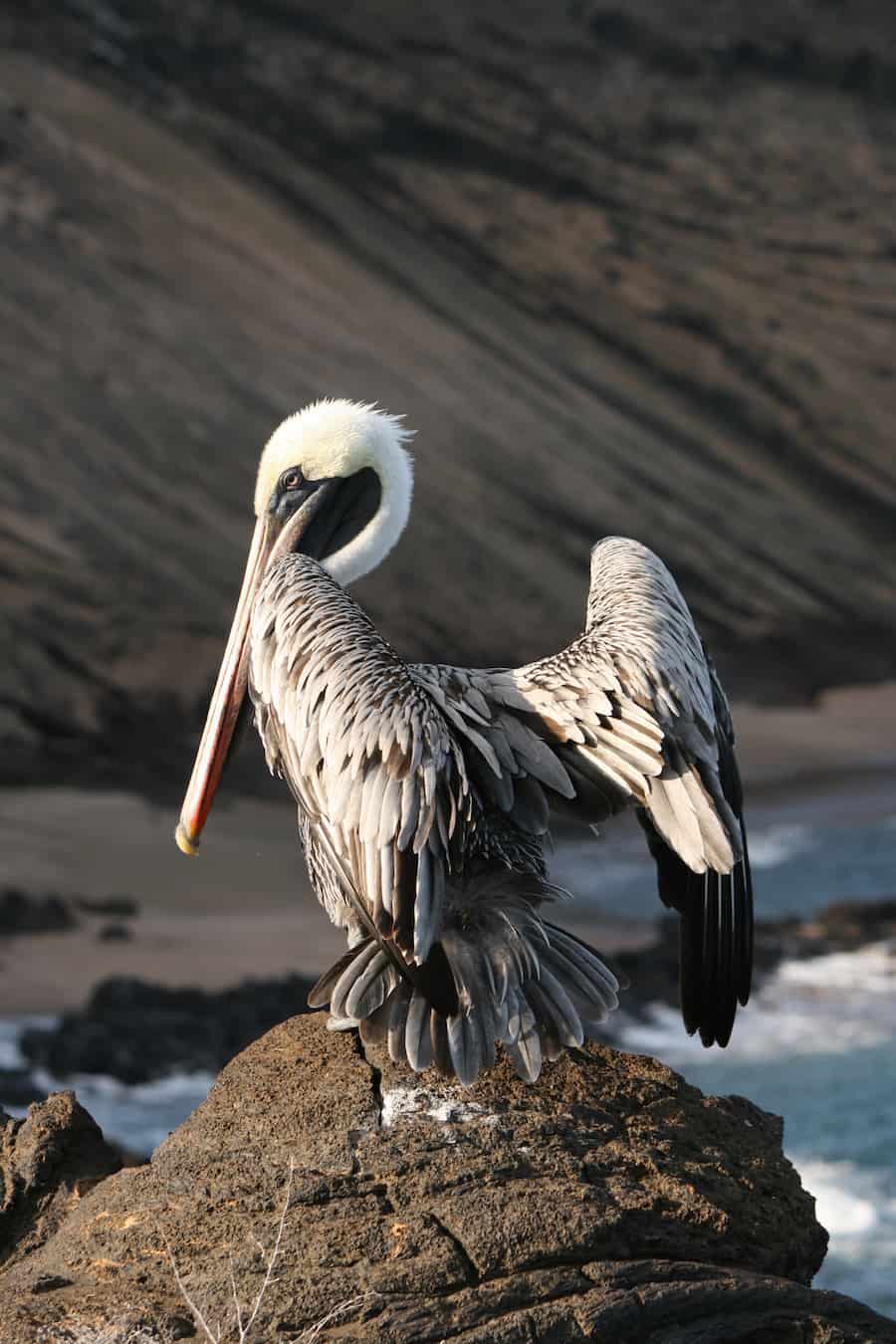
We spot pelicans and tawny brown owls (that’s not the real name, by the way) and frigates (that is the real name) whose crimson neck pouches swell up to attract a mate until they, er, reach success and relieve themselves.
Another creature comes running towards me, and after previous warnings, I start to run away.
It turns out the booby wanted to take off and I was simply in its way.
That’s the bafflingly beautiful thing about the wildlife here – it’s so astonishingly innocent and unafraid.
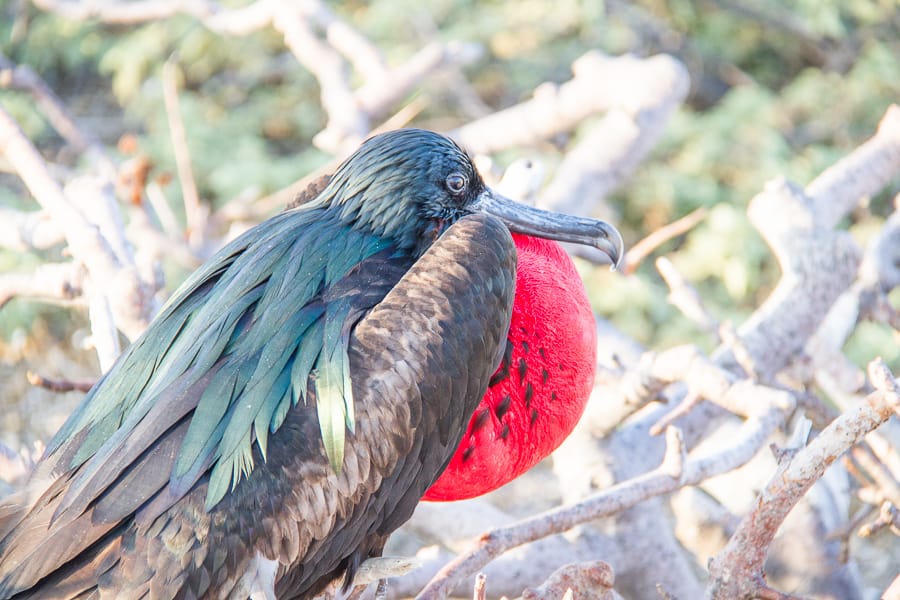
Theories have it that all the wildlife ended up here washed up on rafts during violent storms. Only creatures who could fly or survive the journey populated the islands until the 16th century and the arrival of man.
That explains, apparently, the general lack of mammals – and the overwhelming preponderance of birds.
But no creature has yet learned that as humans, with all our best intentions, we remain the enemy.
An American monkey, after getting drunk on brandy, would never touch it again, and thus is much wiser than most men. Charles Darwin
Back on dry land, the evidence of man is more apparent. The tropical island of Santa Cruz connects by ferry to the island airport and houses Puerto Ayora, a cutesy but busy little port where sea lions stretch across wooden benches and walkways that lead to the sea.
It’s another short boat hop across to the eco resort of the Finch Bay Hotel, with its lilting hammocks, stalking herons and Galapagos finches that swoop to drink water from the pool.
Our time is almost up, but there’s still one thing missing.
Chasing the Sunset
In an exercise of futility, while locals splash in the setting sun on the shore of the sandy beach, we haul a little-used kayak through the sand flies and into the sea.
As a working port, Puerto Ayora rewards us with ships, smoke and the sense of petroleum.
But our navigation is clear.
“Turn right and head for the cliffs,” according to the friendly receptionist at Finch Bay.
It seems unlikely – and she seemed sceptical – but we persevere.
We see nothing but swimming Americans.
Then, just fifty metres away, that curved lolloping limb.
A turtle!
If the sun set right now and we saw nothing else, this moment alone would make it all absolutely worthwhile.
Abs crunched against the oar, I lean forward for a pic.
Splash.
A sea lion rises up beneath the kayak, spurts water that lands on my sunset-soaked thigh, then disappears again.
Terror.
Beauty.
Fascination.
I’m absolutely in love with it all.
After minutes where all I can hear is my breathing, he returns. And dives. Returns again. Dives. Return.
I can feel my heart beating.
When all seems quiet, we drift towards the cliffs.
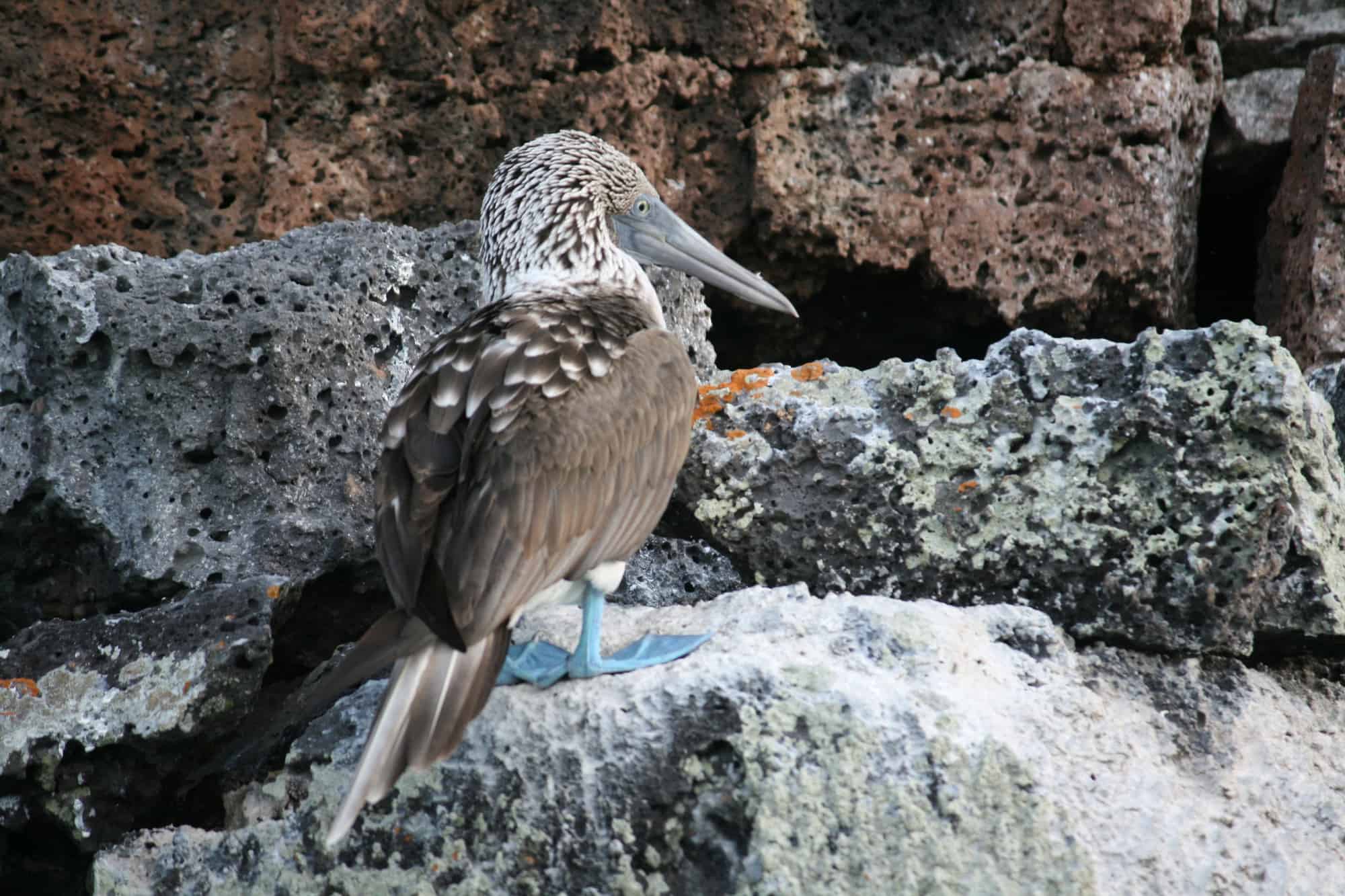
With the setting of the sun bleaching magenta from the sky, the white speckled cliff sides take on a bluer hue.
And there, matching perfectly, as he should be.
Is the legendary blue-footed booby.
And the conclusion of a scientist’s dream.
A man who dares to waste one hour of time has not discovered the value of life. Charles Darwin
Lab Notes
Flights to the Galapagos Islands
I flew from Cardiff to Quito with KLM, switching at Schiphol, Amsterdam. This was also the easiest flight route we found at that time, with no direct flights from the UK (plus skipping the journey down to London).
The closest mainland airport to the Galapagos, however, is Guayaquil, not Quito. And planes that fly between Europe and Ecuador often fly a “triangular” journey between Europe, Quito and Guayaquil.
So only head to Quito if you want to spend some time there (Quito’s oldest covered market is a good start) or explore the rest of the country (like the cloud forest, for example!).
Arranging a Cruise to See the Galapagos Islands
As became clear, the best way to see the most of the Galapagos Islands involves hopping onto a boat. We travelled with La Pinta, arranged by Metropolitan Touring and then stayed for one night at the Finch Bay Eco Hotel. If we had our time over again, we’d swap the two around and probably stay for an extra day on land too.
Cruises can run for up to a week, but most people opt for either three or four nights. Depending on how happy you are to be on a boat, this may well be enough.
Travel Tips for the Galapagos
Don’t expect blue skies and sandy beaches everywhere you look! The islands are quite different from one another and the weather varies a great deal too. You’ll mostly see sunny photos of the Galapagos because that’s when people take more photos – but bear in mind that many of the islands are rocky and the weather can be bleak.
Heading further afield? Here are my South America travel tips.
Disclosure
We paid a reduced rate to travel with Metropolitan Touring and KLM to the Galapagos.
As ever, as always, we kept editorial freedom and remain free to write about as many boobies as we like. Otherwise what’s the point?



You know what Abi? The blue footed Booby bird can also be found in Puerto Vallarta, Mexico…where I live! The species lives in the Galapagos and here; I only found out recently :)
Aaaaah…NOW you tell me! This would have been much easier ;-) That’s Puerto Vallarta, Mexico on the wishlist now then!
So glad you got better soon enough to enjoy some of the islands (and find your booby)! The Galapagos really is spectacular.
Me too! Seems strange to have travelled so far to stay in one place (so to speak) for so long!
These are among the best places on earth to see the diverse life.
And the animals are so…innocent and tame. They really just don’t have any fear of other animals. Incredible to witness.