Learn how to put together an unforgettable trip to Tuscany with this handy itinerary.
Planning Your Tuscany Itinerary
Planning a week in Tuscany presents a particular challenge: how do you balance Florence’s unmissable Renaissance history with the countryside everyone came to see?
When does wine tasting become more important than visiting one more museum, and which medieval towns actually deserve the detour?
I’ve visited different parts of Tuscany many times over and the answer will always depend.
This 7-day Tuscany itinerary offers enough time to answer these questions, balancing iconic cities with small towns, wine tasting with breathing room, must-see art with the unplanned discoveries that become your best memories.
From Florence’s Renaissance heart to Chianti’s vine-covered hills, it’s built for first-time visitors who want both structure and spontaneity.
Here’s how to get it right.
Before You Go: Getting the Logistics Right
It’s time to face a few non-negotiable realities.
When to Visit
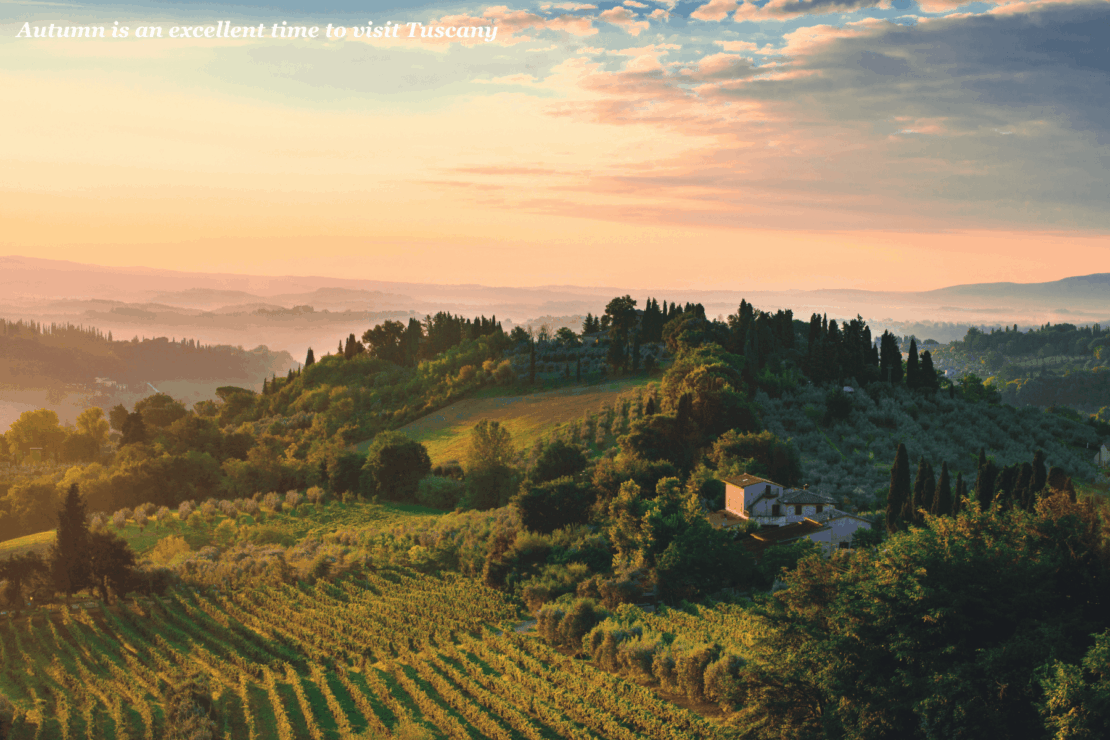
Shoulder seasons (April through June or September through October) deliver the best way to experience Tuscany without the suffocating crowds and prices of high season.
Temperatures hover around 18-24°C, vineyards glow green or gold depending on which end of the calendar you choose, and wine lovers can time visits with vendemmia (grape harvest) in early autumn.
Winter (November-March) brings dramatic discounts of 40-60%, but expect cold rain and some closures.
July and August? Heat climbs to 30-35°C, crowds triple, and you’d be sharing every view with tour buses.
Transport Strategy
Unless you only want to stay in the cities, you’ll need a rental car. The hilltop towns, olive groves, and winding roads through Val d’Orcia simply don’t connect via public transportation in any practical way.
But keep the car far from Florence and Siena, where ZTL (Limited Traffic Zone) cameras photograph license plates entering restricted areas and trigger automatic €80-300 fines that arrive months later through your rental company.
Florence airport sits closest to the city centre (20 minutes by tram for €1.50) if you’re landing here, whilst Pisa International Airport often offers better international connections.
Train connections work (Florence to Siena takes an hour), but you’d miss the entire region’s soul.
The optimal strategy: spend your first two Florence days carless, pick up the rental on day three for countryside exploration, return it on day seven.
Where to Base Yourself
One or two bases work better than constant hotel changes. Florence anchors Days 1-3. This capital city functions as a compact walking city where the historic centre stretches just 30 minutes end-to-end on foot.
For Days 4-7, establish a countryside base rather than moving daily.
Family Stays
Families with children often find that villas in Tuscany with pool offer the perfect balance: space to spread out after days exploring medieval towns and that essential pool where children can decompress whilst parents enjoy evening wine on the terrace.
Celebrations
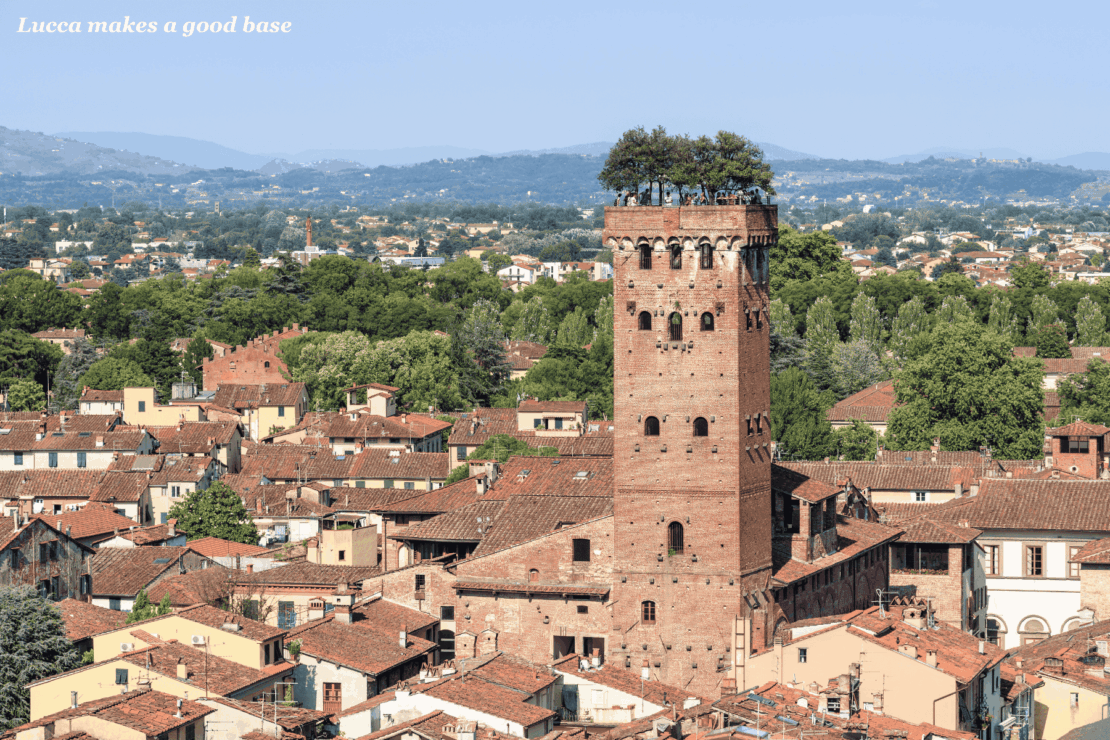
The countryside north of Florence, particularly around Lucca, has become known for venues that capture everything people envision when they think of Tuscan romance: medieval stone, cypress-lined drives, and views across those famous rolling hills.
If you’re planning an anniversary trip or perhaps even considering a Lucca wedding venue for a future celebration, the region delivers that combination of historic architecture and countryside beauty in ways that feel both grand and intimate.
Day 1: Florence and Renaissance Foundations
Your Tuscany education begins where the Renaissance did. Welcome to your first day in Florence!
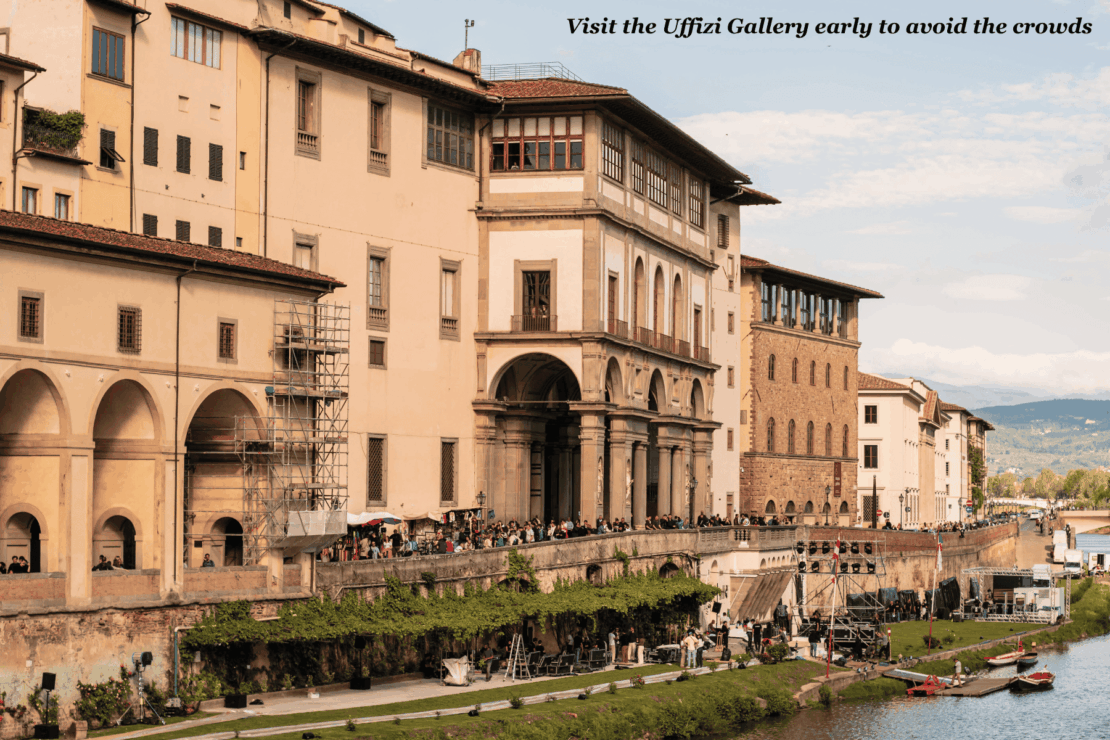
The Uffizi Gallery
Book your Uffizi Gallery tickets for the 8:15 AM opening. This early window costs €19 versus €25 later and delivers 70% fewer crowds than midday chaos.
Walking through these galleries when morning light streams through windows overlooking the Arno River, you understand why Leonardo da Vinci and Michelangelo worked here.
Allocate three full hours to explore chronologically arranged Renaissance masterpieces.
Botticelli’s Birth of Venus stops people mid-stride, that goddess rising from her shell whilst winds blow and spring waits on shore.
See Leonardo da Vinci’s Adoration of the Magi and Michelangelo’s Holy Family in its vibrant circular frame.
Admire the gallery’s frame of Ponte Vecchio through its windows.
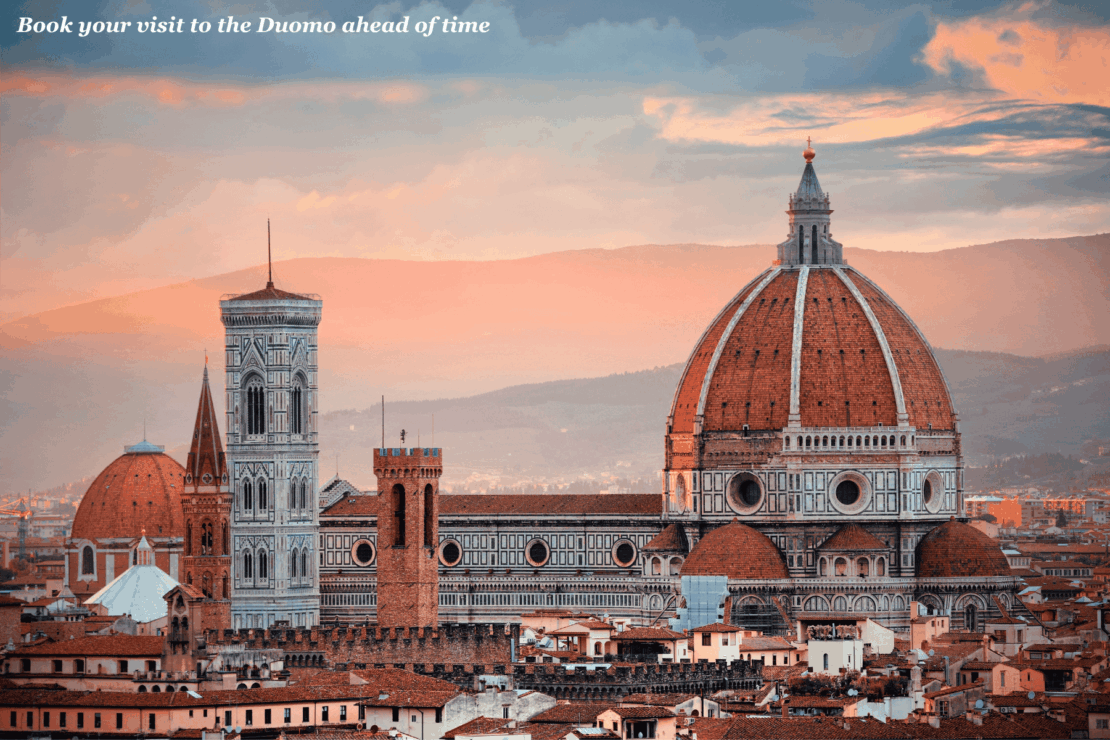
The Duomo Complex
The €30 Brunelleschi Pass covers the essential dome climb: 463 steps spiraling between Vasari’s Last Judgment frescoes to panoramic views that make the breathless ascent worthwhile.
Book 2-3 weeks ahead in peak season; slots sell out regularly.
From the top, Florence spreads below in burnt sienna and terracotta, medieval towers punctuating the cityscape, the Tuscan countryside rolling toward distant hills.
Alternatively, climb Giotto’s Bell Tower next door, with its 414 steps delivering equally gorgeous views with the dome itself in your frame.
Piazzale Michelangelo at Sunset
Save late afternoon for Piazzale Michelangelo. Take bus 12 or 13 from the city centre, or walk the steep 15-minute climb if your knees forgive the earlier tower ascents.
Arrive an hour before sunset with wine and cheese like locals do.
Day Two: Still Florence – Piazzas, Bridges, and Artisan Quarters
The second day shifts from museums to streets, from masterpieces behind glass to the living city where craft traditions survive in working workshops.
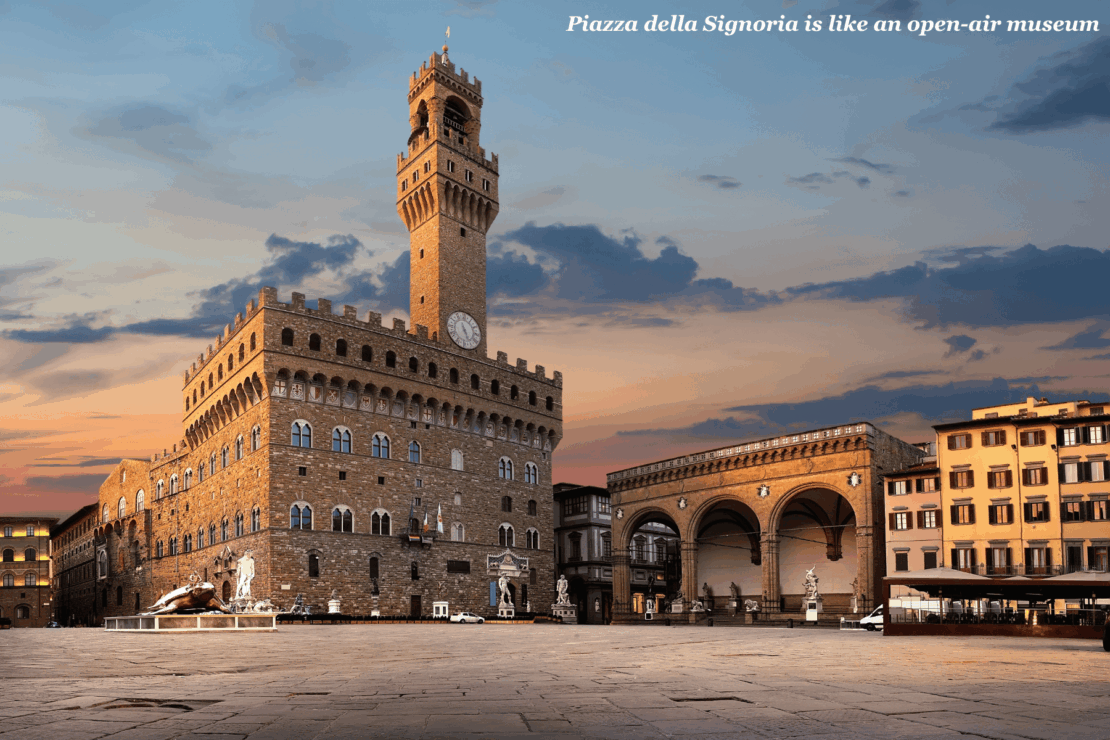
Piazza della Signoria
Piazza della Signoria functions as Florence’s outdoor sculpture gallery, an open-air museum where marble and bronze figures have stood for centuries.
Palazzo Vecchio’s medieval bulk anchors one end, the Loggia dei Lanzi’s arches sheltering Cellini’s Perseus holding Medusa’s severed head.
Spend the morning here, wandering the piazza and perhaps touring Palazzo Vecchio’s interior if Renaissance politics intrigue you.
Ponte Vecchio to Oltrarno
Walk to Ponte Vecchio, a medieval bridge lined with goldsmith shops since 1593 when the Medici evicted the butchers previously occupying the space. The eviction wasn’t about aesthetics; it was about smell.
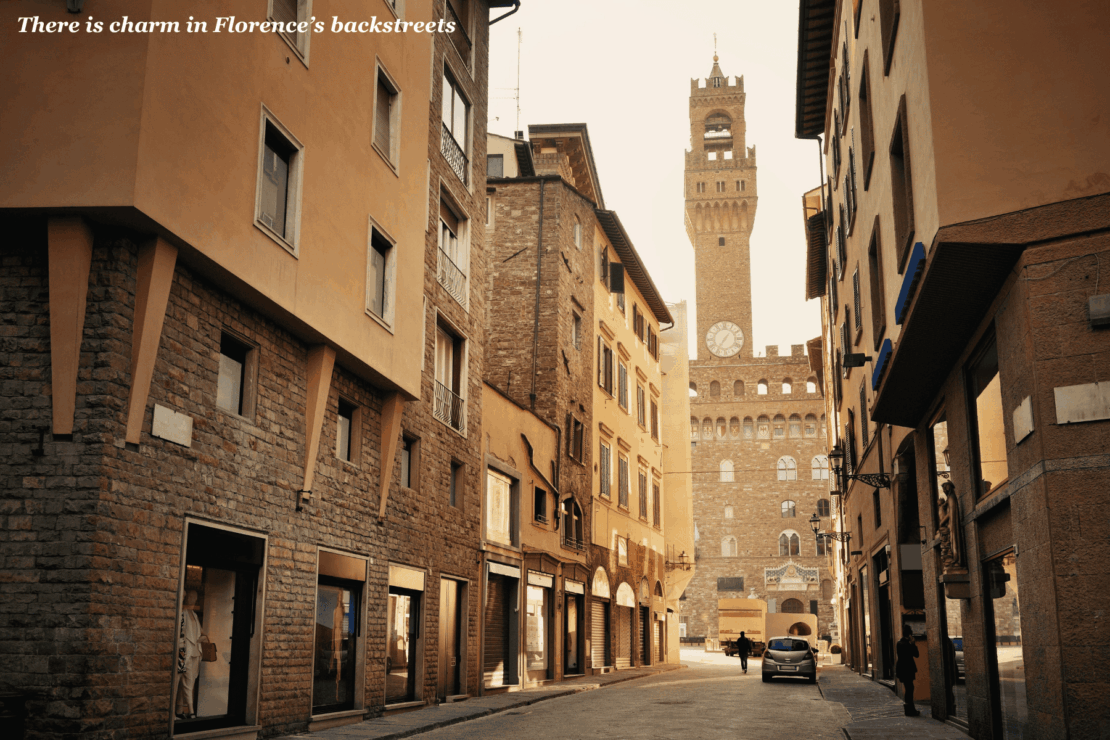
Cross into Oltrarno and the cobblestone streets take on a different character, slightly rougher around the edges, more lived-in. This is where Florence still functions as a city rather than a museum.
Practicalities
Oltrarno neighbourhood delivers an authentic atmosphere without tourist-trap pricing. The narrow streets hide trattorias where Florentines actually eat. Look for handwritten menus, paper tablecloths, and grandmothers visibly cooking in back kitchens.
Santa Croce provides Sant’Ambrogio market access, where you’ll assemble provisions for the next day, when you’ll be winding through the countryside with limited restaurant options between medieval towns.
Choose from wheels of pecorino, prosciutto sliced to order, bread still warm, and those small, hard biscotti perfect for hiking between hilltop villages.
Day 3: Medieval Towers and Hilltop Magic
An hour northwest of Florence, fourteen medieval towers pierce the skyline in what feels like architectural time travel.
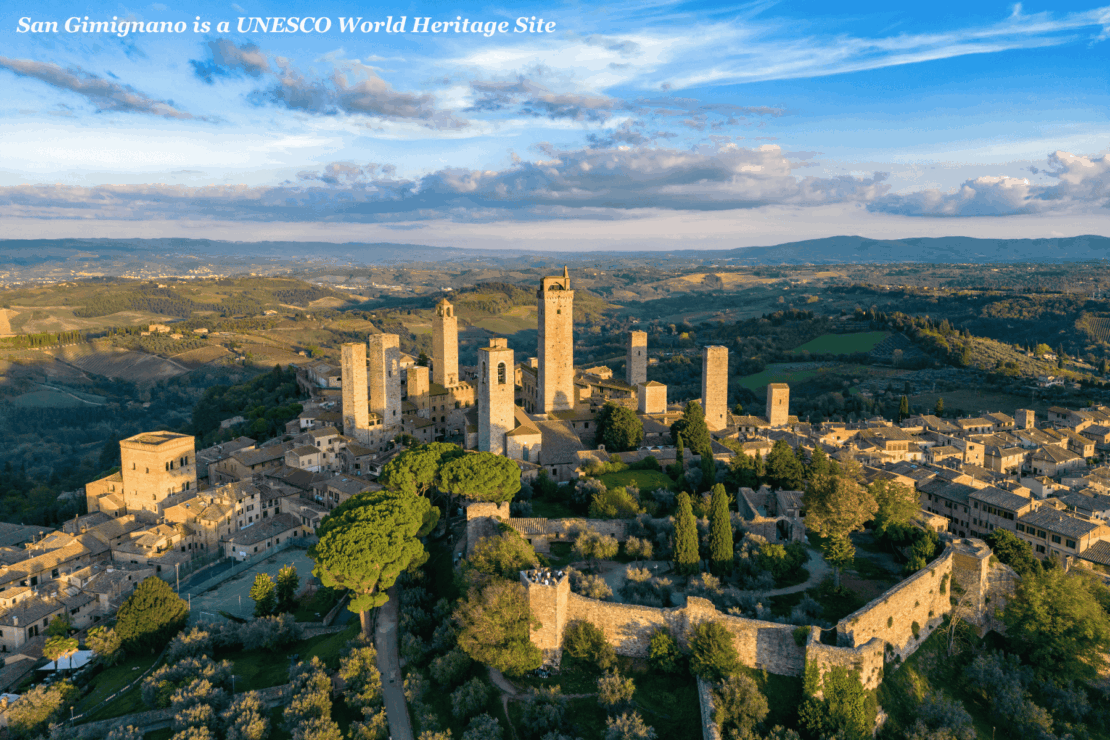
San Gimignano: The Medieval Manhattan
The ancient walls of this UNESCO World Heritage Site preserve a feudal atmosphere so completely that wandering its cobblestone streets could be 1350 or yesterday.
The 14 surviving towers, remnants of the original 72 built by wealthy families as literal power symbols, create Italy’s most distinctive skyline. Each tower represented a family’s status; taller meant more influential.
They’ve stood since the 1200s, honey-coloured stone weathering centuries whilst the families who built them faded into history.
Climb Torre Grossa, the tallest at 54 metres, for views across vineyards toward Volterra. The €10 ticket includes Palazzo Comunale’s museums.
Allocate 3-4 hours minimum for this beautiful medieval town. Notice how windows narrow as towers climb, how each generation added layers to what came before.
Practical tip: Parking spaces are outside the city walls, all within a 5-10 minute drive. €2 hourly. ZTL cameras enforce restrictions strictly. Don’t test them.
Volterra: The Etruscan Alternative
From San Gimignano, Volterra makes an excellent 30-minute detour for those seeking smaller towns with deeper history.
This 550-metre hilltop village delivers a 4th-century BC Etruscan gateway (best-preserved in Italy), remarkably intact Roman theatre, the beautiful Piazza dei Priori, and alabaster workshops continuing centuries-old traditions.
Watch artisans transform the translucent stone using techniques unchanged since their grandfathers’ time.
An hour suffices for a brief stop; archaeology enthusiasts could easily spend half a day.
Either way, these smaller towns deliver authenticity lacking in more famous destinations. The medieval walls here enclose genuinely working communities, not museum pieces preserved in aspic.
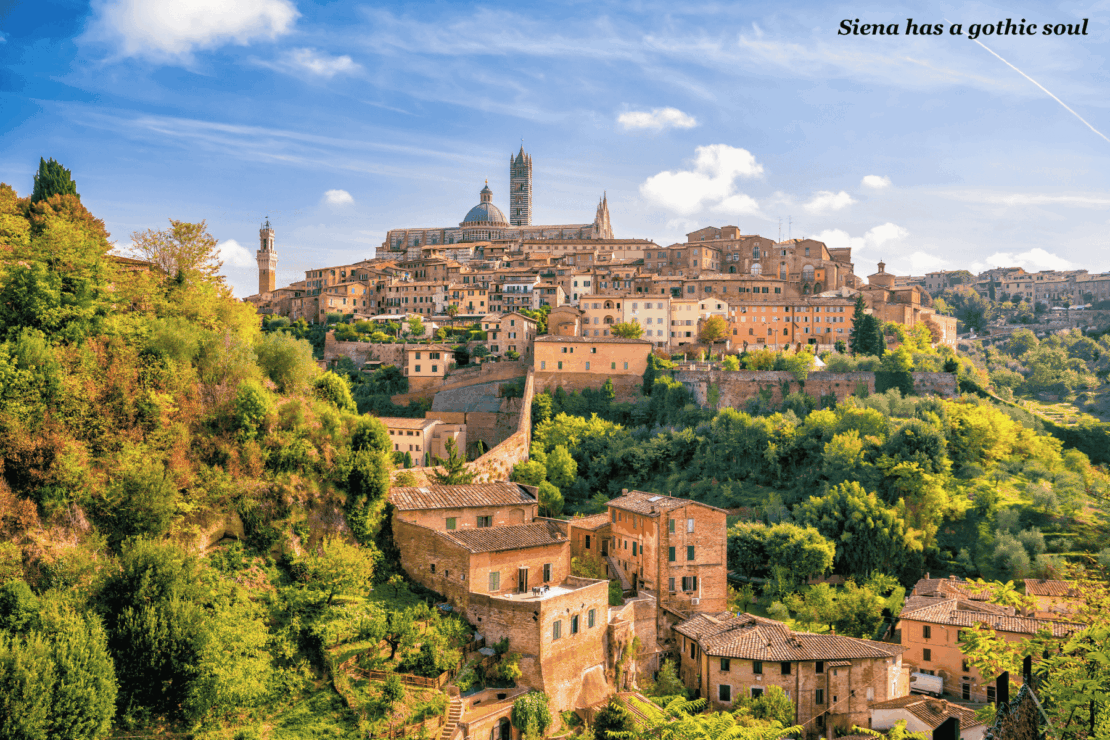
Day 4: Siena’s Gothic Heart
Where Florence celebrates Renaissance humanism, Siena clutches its Gothic medieval soul. The shell-shaped piazza at its heart has witnessed 700 years of passion, rivalry, and that wild horse race that still defines this historic city’s identity.
The Shell-Shaped Square
Piazza del Campo slopes like an ancient amphitheatre, its brick-paved curve drawing locals and visitors to sit, observe, and absorb the rhythm of Italian life.
The design isn’t accidental. Twice yearly, on 2nd July and 16th August, horses race in The Palio: 90 seconds of bareback chaos following four days of medieval pageantry.
A Tower Worth Climbing
Torre del Mangia’s 400 steps require 10 minutes of narrow, dark ascent, becoming sweaty and breathless. The reward (102 metres above Piazza del Campo) provides perspective on how those contrade districts divide the city of Siena like medieval fiefdoms.
From this height, terracotta rooftops flow toward distant vineyards, the Tuscan landscape rolling in earth-toned waves toward Val d’Orcia. Morning coffee or aperitivo hour, either time works for absorbing the piazza’s atmosphere from street level, though aperitivo brings better light.
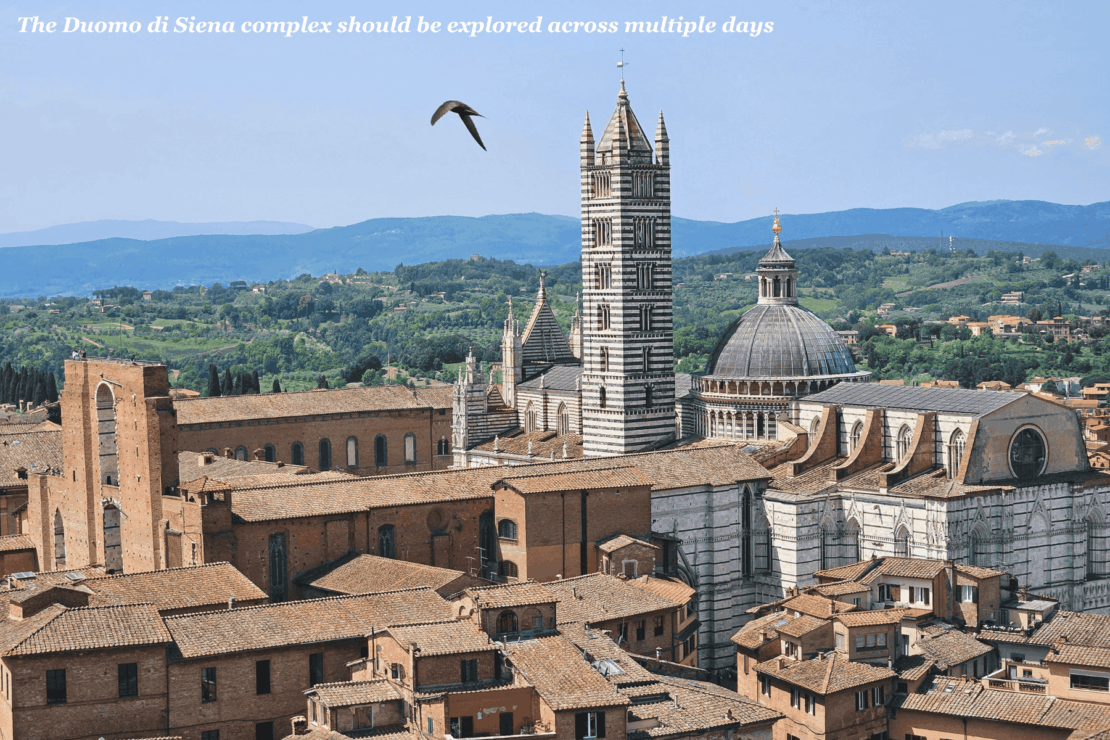
The Cathedral Complex
The OPA SI Pass (varies seasonally: €14–21 ) unlocks the complete Duomo di Siena complex across three consecutive days: the black-and-white striped marble cathedral with its lapis lazuli ceiling, the Piccolomini Library’s Pinturicchio frescoes, the recently discovered crypt’s remarkably preserved medieval art, the baptistery, museum, and Facciatone panorama viewpoint.
From 27th June to 15th October, the cathedral uncovers its famous marble inlay floor: intricate figured panels normally protected beneath wooden boards.
These 56 panels, created between 1369-1547, depict biblical scenes in coloured marble with three-dimensional effects.
Practicalities
Park outside ZTL zones. Parcheggio Stadio near the train station offers free parking all day after the first hour at €2.
When hunger strikes,Osteria Le Logge on Via del Porrione balances traditional Tuscan foundations with refined presentation (€35-50). For casual family dining, Antica Trattoria Papei serves generous portions (€25-35).
Siena works as either a day trip from Florence (one hour drive) or from your countryside base.
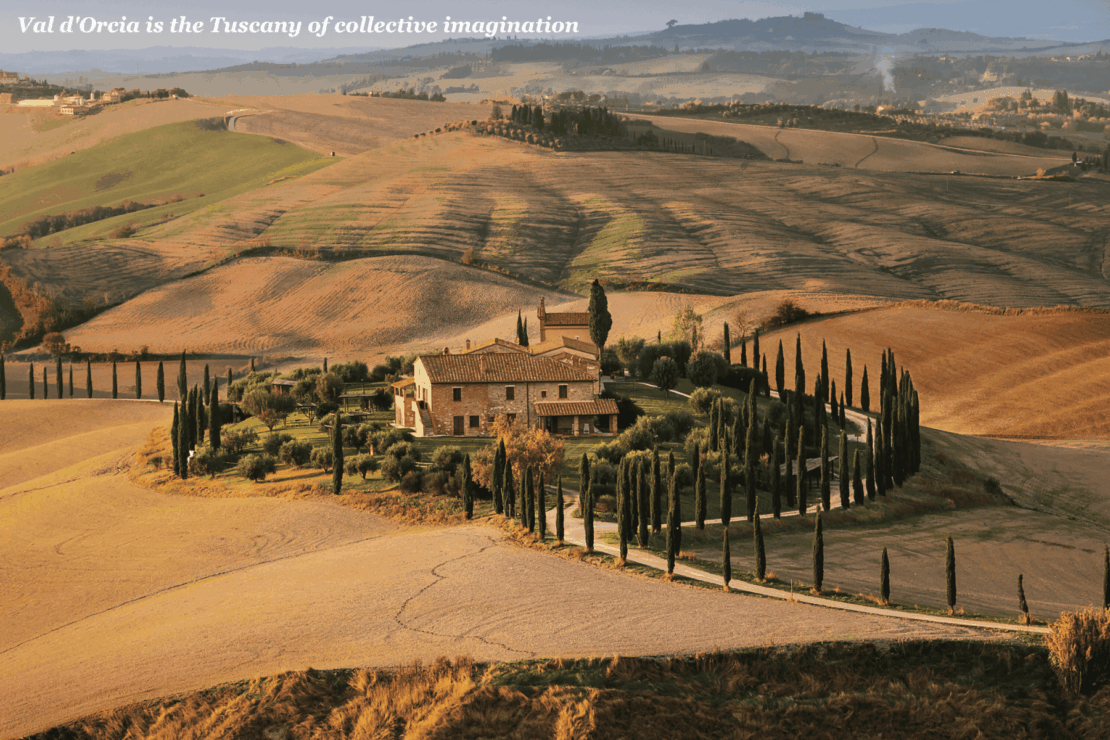
Days 5-6: Val d’Orcia – Where Postcards Come From
This is the Tuscany of collective imagination made real: rolling hills striped with wheat and vines, cypress trees in perfect formation, and isolated stone farmhouses commanding ridge lines.
The UNESCO Landscape
Renaissance painters who worked here captured the countryside perfectly. Those gently undulating green hills, those sentinel cypresses marking field boundaries. Right from the scenes of the original Gladiator.
Two days minimum lets you properly explore without constant packing. This is where the main thing becomes not seeing but experiencing: the pace, the light, the way an hour can pass watching cloud shadows move across the hills.
Pienza
Pope Pius II transformed his birthplace, Pienza, into a utopia of urban planning back in the 15th century.
Today, you can still walk those honey-coloured stone streets past shops stacked with wheels of pecorino di Pienza (sheep’s milk cheese flavoured by aromatic herbs growing in Val d’Orcia’s poor soil.)
Sample cheese aged in oak barrels, rolled in walnut leaves, and black pepper. The flavour shifts dramatically based on the aging method: three months delivers mild creaminess, twelve months brings sharp complexity.
Allocate 3-4 hours minimum for this small village. Longer if you’re sampling seriously.
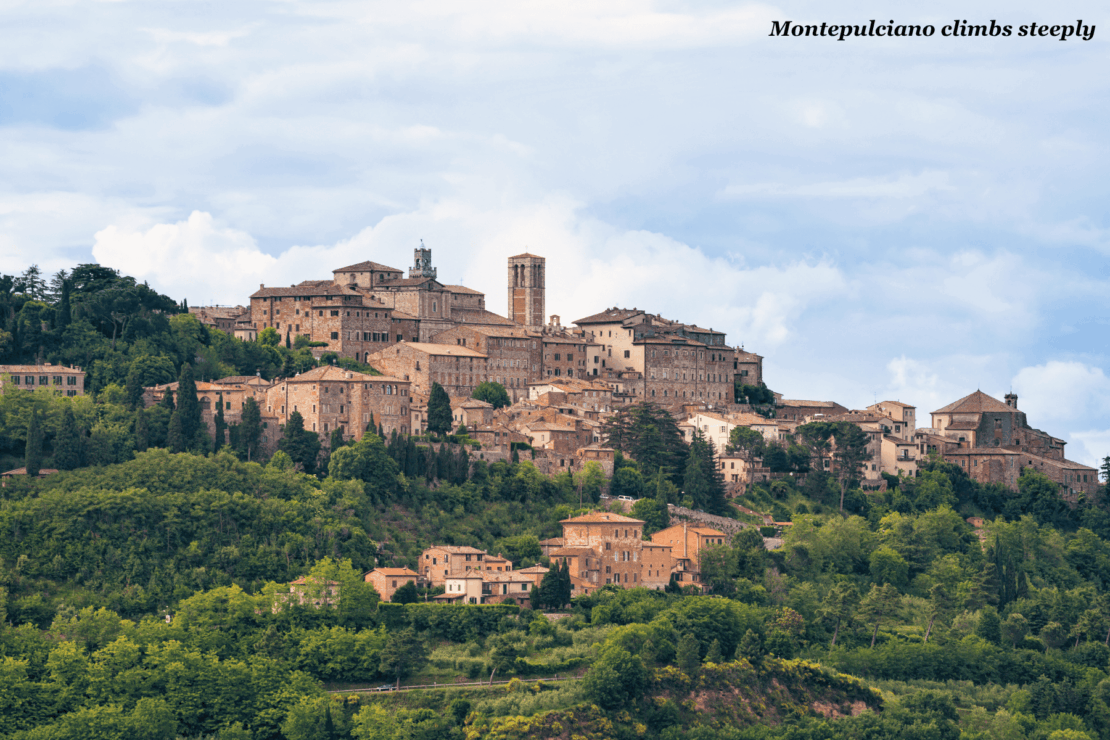
Montepulciano
Montepulciano climbs steeply, 600 metres of cobblestone ascent from Porta al Prato to Piazza Grande at the summit, delivering a cardiovascular workout.
This hilltop village rewards wine lovers specifically. Underground cellars carved into volcanic tufa rock age Vino Nobile di Montepulciano, that DOCG blend of Sangiovese, achieving deep ruby colour and complex cherry-plum-olive flavours.
Wine production here dates to the 8th century and you can enjoy a wine tasting with Contucci Cantina on Piazza Grande, just steps from the cathedral. An astonishing five generations of the family have occupied this Renaissance palace.
Elsewhere, the Enoteca at Fortezza Medicea offers wine-dispensary systems where you can taste multiple producers.
Palazzo Comunale’s tower does show great panoramic views across both Val d’Orcia and Val di Chiana, though by the time you’ve climbed those cobblestones, the joy of another tower ascent may be wearing thin.
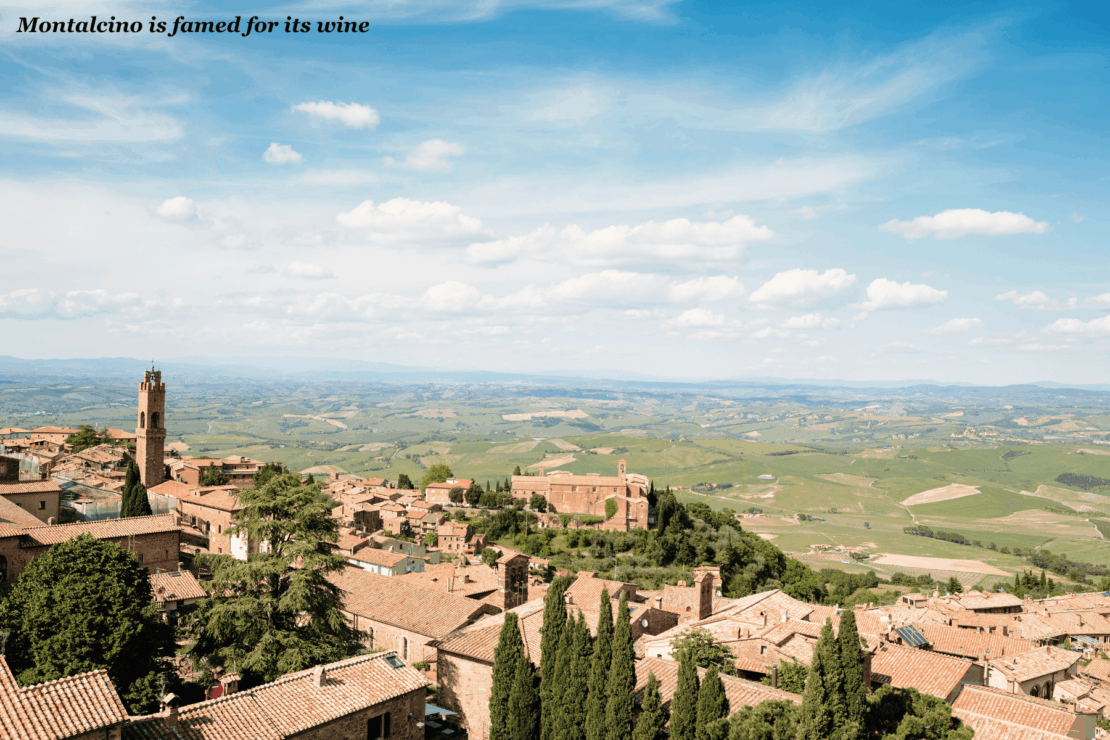
Montalcino
Montalcino guards Tuscany’s most prestigious treasure from its hilltop: Brunello di Montalcino, the 100% Sangiovese Grosso wine aging for at least four years before release, coveted by collectors worldwide.
The wine region’s 240 producers occupy surrounding hillsides, their vines benefiting from altitude and microclimate, achieving a complexity that the regular Chianti region can’t match.
Prices reflect this. Bottles start at €40 and climb rapidly. The 14th-century Rocca fortress houses Enoteca la Fortezza, where you can taste both Brunello and its younger sibling Rosso di Montalcino whilst gazing across vineyards. The €15-25 tasting fee seems steep until you consider these wines’ actual cost.
The Abbey of Sant’Antimo sits 10 kilometres south in tranquil hills. This Romanesque jewel, dating from Charlemagne’s era, rewards late afternoon visits when golden light warms travertine stone. Even better? Entry is free. It’s also worth noting that the monks sometimes perform Gregorian chants during vespers – check the timings if that interests you.
Those Famous Cypress Trees
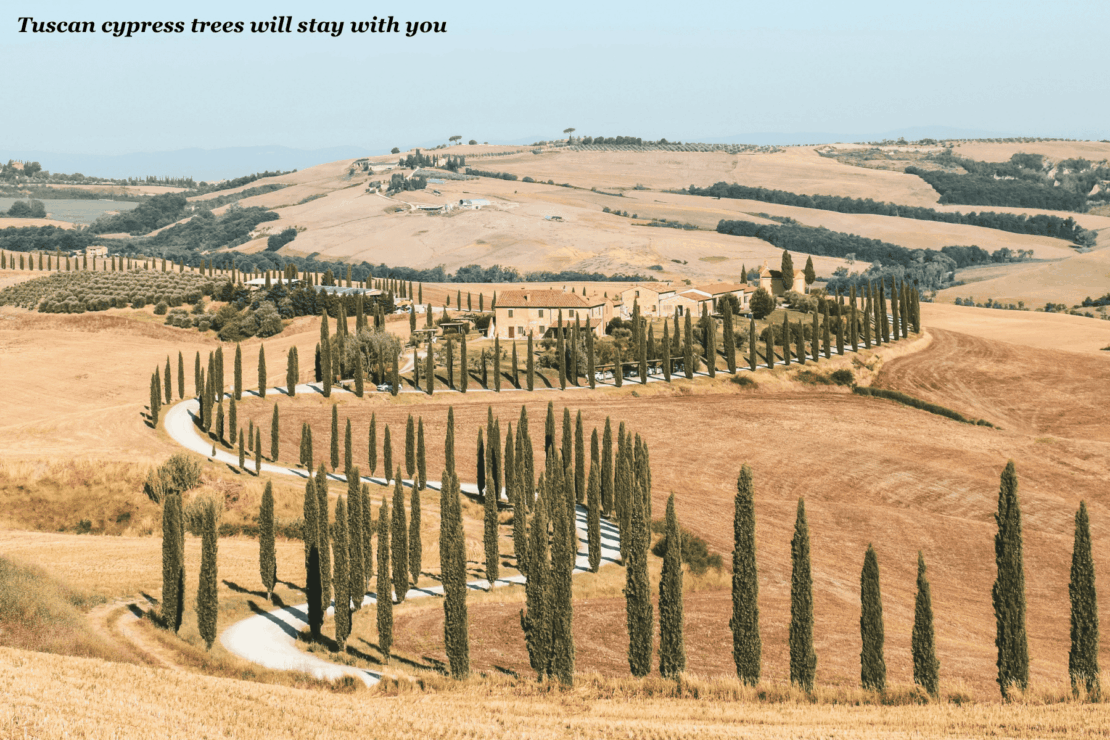
The circular grove on the SR2 before San Quirico has become one of the world’s most photographed. Created by hunters to attract birds, these trees, arranged in perfect formation, now define how we envision the Tuscan countryside.
The Cappella della Madonna di Vitaleta, flanked by two cypresses between San Quirico and Pienza, works best at sunset. Arrive early; it’s popular.
La Foce near Montepulciano delivers that classic serpentine composition everyone came for. Drive the SR146 panorama road slowly, as this scenic drive reveals postcards around every bend. Sunrise or sunset transforms the landscape entirely.
Practicalities
San Quirico d’Orcia offers the most strategic base, equidistant from the main towns: Pienza (10km), Montalcino (20 minutes), and Montepulciano (25km).
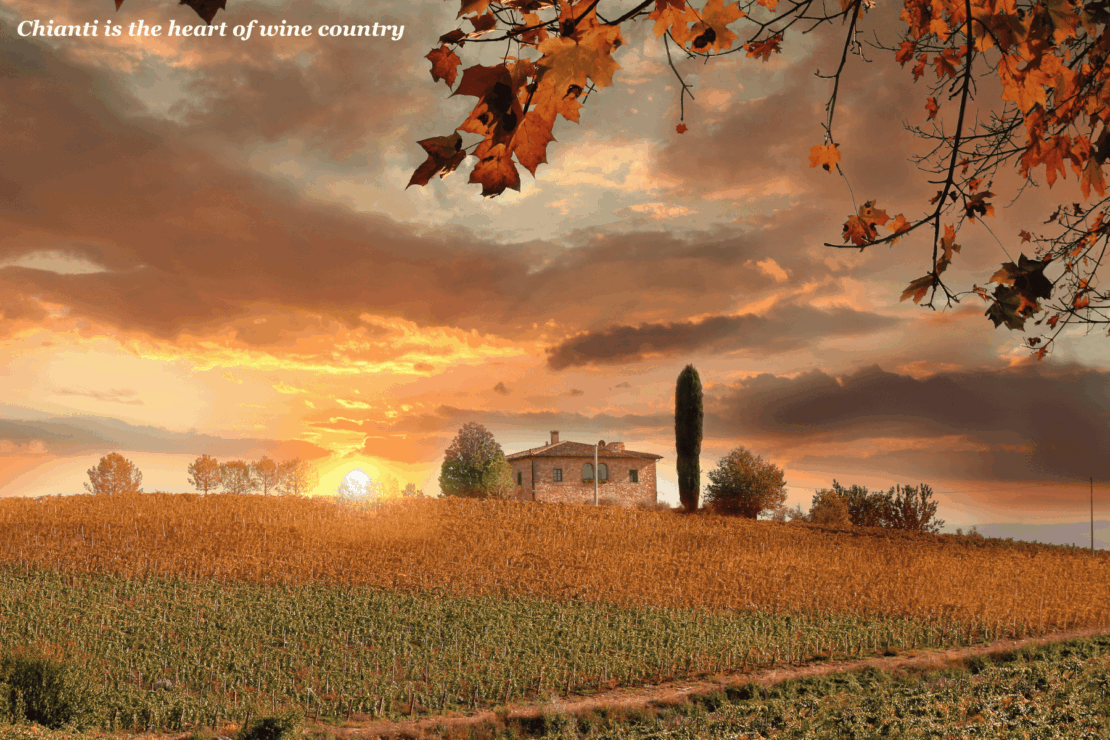
Day 7: Chianti – The Heart of Wine Country
The SR222 Via Chiantigiana winds 69 kilometres through the soul of Chianti Classico, connecting Florence to Siena through vine-covered hills where the black rooster (Gallo Nero) symbol marks estates producing Tuscany’s most famous wines.
This is your Tuscan road trip finale.
The Via Chiantigiana
This two-lane road deserves 3-4 hours minimum with stops. Vineyards cascade down hillsides and medieval villages crown strategic peaks.
The black rooster symbol marks Chianti Classico consortium members. Look for it on bottles, winery signs, and estate gates. It distinguishes genuine Chianti Classico from regular Chianti.
Stop often because every bend offers a different composition, every village suggests lunch possibilities, and every estate makes you reconsider whether you actually need to return that rental car today.
Villages Worth Stopping At
Greve in Chianti functions as the region’s unofficial capital, with its triangular Piazza Matteotti surrounded by porticos housing wine shops offering tastings.
Panzano in Chianti draws those who worship at the altar of bistecca fiorentina to Dario Cecchini’s legendary butcher shop.
Castellina in Chianti‘s medieval fortress and Via delle Volte covered walkway reward exploration.
Radda in Chianti preserves its medieval layout perfectly.
You won’t have much time, so pick 1-2 based on what appeals. Each has a distinct character beyond wine: morning markets in Greve, butcher theatre in Panzano, medieval atmosphere in Castellina.
Where to have lunch depends on which village you choose. Trattorias in each serve proper Tuscan food without tourism markup. And remember that the hills of Chianti produce more than just wine: the olive groves here yield oil that locals will tell you rivals anything from further south.
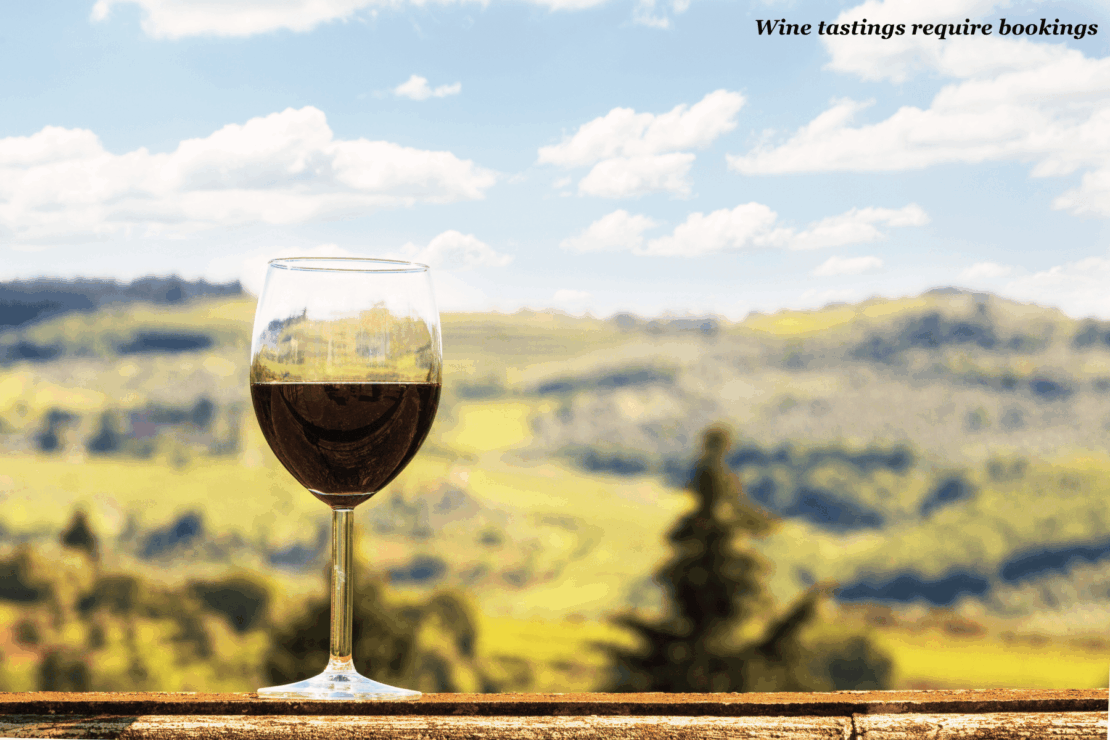
Wine Tasting Done Right
Book 1-2 weeks ahead in the high season. You can’t simply show up expecting tastings – estates require reservations.
Castello di Brolio offers the most comprehensive experience: the Ricasoli family has produced wine here since 1141, and Baron Bettino Ricasoli defined the original Chianti Classico formula. Tours range from basic tastings (€30-50) to elaborate experiences including cellars, vineyards, and multi-course lunches (€75+).
Viticcio near Greve provides a family-friendly atmosphere with 360° vineyard views and a saltwater pool, helpful if children have reached their medieval architecture limit.
Castello di Volpaia occupies an entire walled medieval village.
Badia a Coltibuono, a former monastery, combines Chianti Classico and estate olive oil tastings in historic splendor.
What Wine Lovers Should Understand
Sangiovese grown in the Chianti hills achieves a different character than Montalcino’s Brunello or Montepulciano’s Vino Nobile. Same grape, different soil, altitude, microclimate. Taste them side by side over these days and you’ll understand terroir isn’t marketing speak.
Why These Prices?
Production methods, aging requirements, DOCG regulations. Chianti Classico demands a minimum of 12 months aging. That’s time, space, and capital tied up before earning a single euro. Chianti wine tours provide context, making those prices sensible rather than shocking.
Alternative: Cooking Class
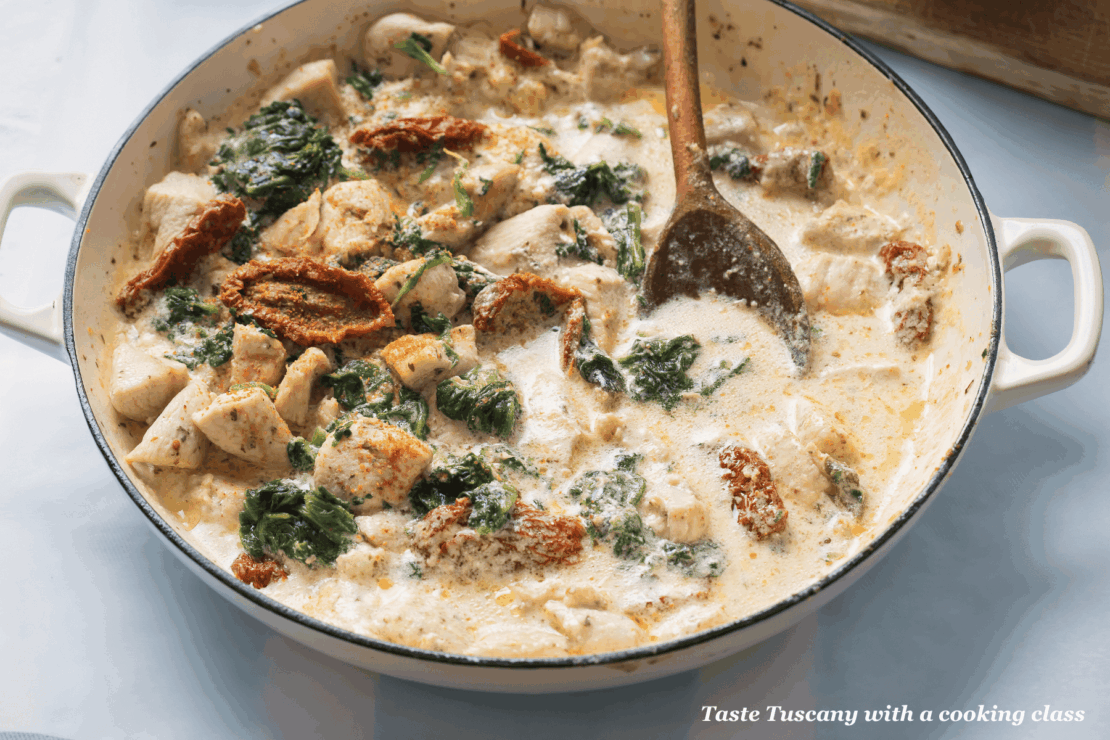
For families or those preferring interactive experiences over wine tasting, consider a cooking class as your Chianti experience.
Good Tastes of Tuscany operates from a 13th-century castle tower, offering hands-on pasta and traditional Tuscan menu classes followed by five-course lunches with estate wines (€130).
Ancora del Chianti B&B provides intimate 3-hour classes focused on fresh pasta (€100-130). Children can participate in age-appropriate tasks: rolling pasta, shaping gnocchi, assembling antipasti.
These experiences deliver cultural immersion that museums can’t match. Also, you’ll actually remember how to make that pasta when you return home, which is more than can be said for distinguishing between the fourteen Chiantis you tasted.
Free time afterwards lets you explore whichever village you’ve based yourself in before driving back to Florence.
Alternative Routes and Adjustments
Not everyone has exactly seven days, and not everyone prioritizes the same experiences. Here’s how to adapt this framework to your reality.
Lucca offers Renaissance walls where you can cycle, and Puccini’s birthplace if you need a full-day trip addition.
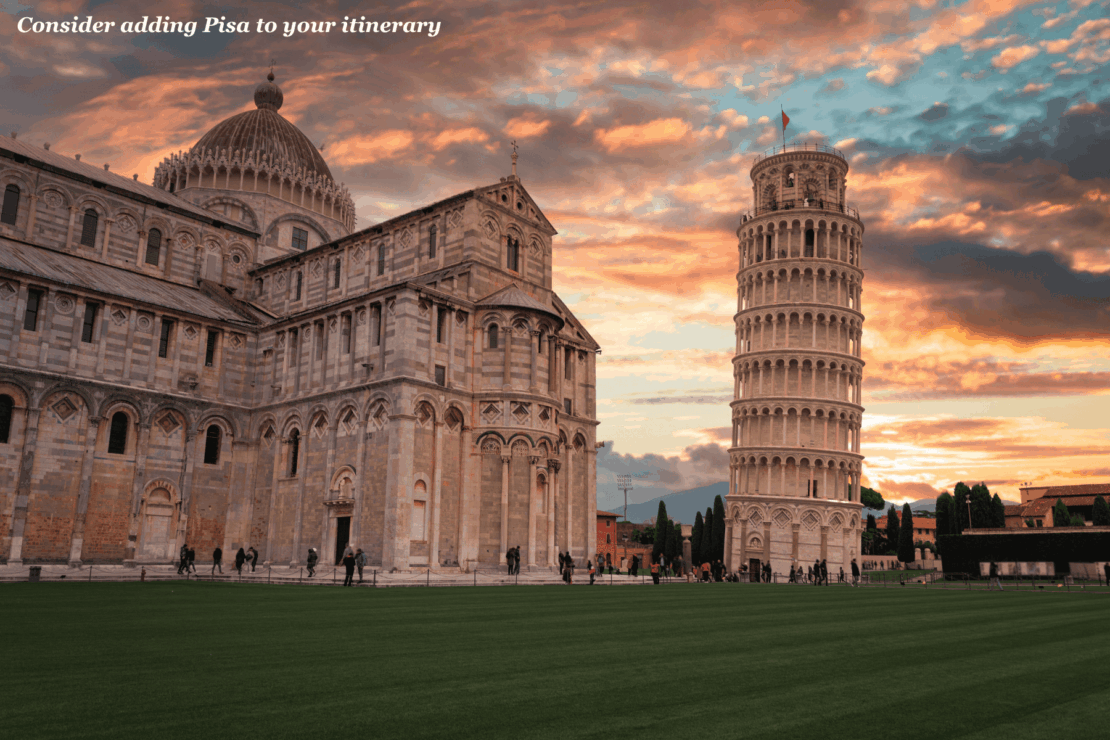
The Leaning Tower of Pisa requires advance booking 90 days maximum (€20, 251 steps). Is it worth it? That depends on whether you’re driven by bucket lists or genuine interest. You can still see it leaning away without getting too close and the Pisa Airport can be convenient for flights.
Cinque Terre sits 2.5 hours each way by train from Florence. The travel time cuts into actual exploring and it’s a very popular area. I’d recommend not trying to cram it into a seven day Tuscany itinerary.
Cortona delivers a hilltop village atmosphere minus San Gimignano’s crowds, though “Under the Tuscan Sun” raised its profile considerably.
San Miniato focuses on truffles rather than towers, different from San Gimignano despite similar names.
For short stays: compress to Florence (2 days) plus one countryside base (Val d’Orcia or Chianti). Pick one region rather than rushing through both. The 5-day sweet spot: Florence (2), Siena (1), Val d’Orcia base (2) with Chianti drive on departure day.
What to skip without guilt: secondary hilltop towns beyond San Gimignano, multiple wine tastings when one comprehensive estate visit suffices, and Volterra if archaeology doesn’t fascinate you. Day trip versus overnight decisions depend on whether evening transformation matters (San Gimignano, yes, other small villages, less so).
The Tuscany That Stays With You
Seven days deliver more than just the beauty of those cypress trees at sunset. (Even though the beauty of those cypress trees at sunset truly do explain the Renaissance artists’ obsession with light and landscape.)
Safe travels, and may your first trip to Tuscany be merely the beginning. When you are ready, here’s our collection of unusual and hidden things to do in Tuscany.
More About Travel in Italy
- 31 hidden gems in Tuscany
- Amazing things to do in Umbria, Tuscany’s overlooked neighbour
- How to get off the beaten path in Italy with 101 hidden gems
- How to make a real ragu: the traditional Italian dish you can make at home
- What to pack for Italy: the ultimate guide
- Florence or Milan for your next trip?
- The travel tips for Italy that you need for your next trip
- A first-timer’s guide to the Amalfi Coast